Showing posts with label england. Show all posts

Wednesday, October 26, 2011

Evelyn Medows and Clara Hayward, 1776 in Town & Country Magazine

Evelyn Philip Medows (1736 to 1826) was featured in a satirical article in Town & Country Magazine in 1776. The series, called "History of the Tête-à-tête", mocked some of the illicit or scandalous love affairs of the day. Each article was accompanied by an engraved portrait of the man and woman involved, in an oval frame, presented facing each other. Many of these portraits have found their way to the British Museum's collection, though currently I can't find this particular set (Numbers IV and V) in the catalogue.


There are a few things I'd like to pass along about this satire.


The reference for the actual article is "History of the Tête-à-tête annexed: or, Memoirs of P_____ M______, Esq; and Miss Clara H_____d. (No. 4, 5)" in The Town and Country Magazine of February 1776, at page 65, with the engravings on the page between 64 and 65. The page with the engravings shows a date of March 1, 1776, but the online version of the magazine is quite clearly the February 1776 issue. It caused me a little confusion when I found the article referred to as being in the March edition, so, don't do what I did and go looking in March. The thing you want is in February.


It's a bit confusing that the man is identified (cryptically but not impenetrably) as Philip Meadows, Deputy Ranger of Richmond Park. Philip Meadows, whose name often uses the Meadows spelling, unlike most other family members, who show as Medows, was the father of Evelyn Philip Medows. Philip Meadows Esquire was born in 1708 and died in 1781. His wife, Lady Frances Pierrepont, lived from 1713 to 1795. While it is entirely possible that Philip had a mistress or two in his day (I've seen nothing either way on this), Philip was probably more than 40 years older than Clara Hayward, and at the time of these portraits in 1776, would have been 63 years old. I'm thinking that such a gap in age, had it existed, would have been remarked upon in the satire, and also that this picture looks like a younger man.

Evelyn Philip Medows, on the other hand, lived from 1736 to 1826, making him about 14 years older than Clara and aged 40 during the heyday of their romance. Some records say that Evelyn married Margaret Cramond, and in one of the Duchess of Kingston's letters, she mentions his wife. However, when this marriage occurred and how long it lasted, I don't know. I haven't seen records of any surviving children.

I don't know why Town and Country identified him as Philip Meadows, nor do I know whether Evelyn Medows ever held the position of Deputy Ranger of Richmond Park. It is quite possible that he did: his father had that role, as did his uncle Sidney Medows (from whom Evelyn eventually did inherit a substantial fortune, including his house in Charles Street). John Stuart, 3rd Earl of Bute, was Prime Minister of Great Britain in 1762-1763, and Ranger of Richmond Park from 1761 (whether until his death in 1792 or some earlier date, I don't know, but he occupied White Lodge in the park during this whole time, apparently).

The Earl of Bute was connected by marriage to the Pierrepont family (notably to Evelyn Pierrepont, Duke of Kingston, brother to Lady Frances Medows nee Pierrepont) and thus to the Medows. Evelyn Medows was the eldest son of Lady Frances, and the eldest nephew of the childless Duke, making him the heir apparent of the Pierreponts. It wouldn't surprise me if the Earl favoured him with a home at Richmond Park. However, I have no proof at all that Evelyn was ever the Deputy Ranger. I'm casting about for an explanation as to why Town and Country gave the description they did.

At any rate, the satire tells of how the young man was a favourite hunting companion of the King of Prussia and had visited Voltaire in France. Disappointed in love in England, he took a three-month tour of the country, eventually settling into his post at Richmond Park. He saw the lady on the stage and was smitten; took her to Richmond and there they lived in rural contentment.


There is no question about the Town and Country lady's identity. She is Clara Hayward, an actress about whom I've only found snippets on the Web. In the satire, her story is one of rags to riches, or at least from rags to comfort at the expense of a series of men, including a lawyer and a dashing officer. She appears as a supporting character in a variety of books about the life and times of women in the 18th century and I believe there is much more known about her than I have found in my Web surfing. Here are a few quotes about Clara.


Early training

From an excerpt of the scanned version of England's mistress: the infamous life of Emma Hamilton, by Kate Williams, published by Hutchinson, 2006; excerpt in scanned version viewed courtesy Google Books:

Aspiring actresses competed for a place at Kelly's for many stars of the eighteenth-century London stage, including Mrs Abington and Clara Hayward, had learnt posture and dance at Arlington Street.


***

Early fame (1760s)

From an excerpt of the scanned version of Ladies fair and frail: sketches of the demi-monde during the eighteenth century, by Horace Bleackley, published by Dodd, Mead and Company, 1926; excerpt in scanned version viewed courtesy Google Books.

This [the 1760s] was the time when giddy Nan Catley was at her zenith, when spendthrift Baddeley had reached the height of her fame, when the youthful Clara Hayward had begun to conquer all hearts with her dainty ways. Nevertheless, from the year 1769 till the year 1773 Miss Kennedy remained as great a favourite with the bucks and bloods as any of these pretty actresses.

 ****

1770 theatrical debut

From an excerpt of the scanned version of The Letters of David Garrick, by George Morrow Kahrl, published by Belknap Press of Harvard University Press, 1963; excerpt in scanned version viewed courtesy Google Books.

Clara Hayward made her debut at Drury Lane on Oct. 27, 1770; she appeared in a number of roles, with varying success, and after March 1772 her name no longer appears on the Drury Lane playbills (Theatrical Biography, 1772, I, 20-23 …

****

1772 with Evelyn Medows

From A Biographical Dictionary of Actors, Volume 7, Habgood to Houbert: Actresses, Musicians, Dancers, Managers, and Other Stage Personnel in London, 1660-1800,  by Philip H. Highfill, Kalman A. Burnim, Edward A. Langhans, SIU Press, 1982; excerpt in scanned version viewed courtesy Google Books:

Clara Hayward (fl. 1770—1772) actress. The 1772 edition of Theatrical Biography reported that Miss Clara Hayward came from an obscure and humble background (her mother dealt in oysters, said the Town and Country Magazine in February 1776).  

She attracted the attention of a young guards officer who initially wished only "temporary gratification," but, charmed with her mind as well as her person, he taught her to read. When he left her, she "fled to her books as an asylum, which she occasionally relieved with a lover." Her reading attracted her to tragedy and to the stage, and through a friend who knew Samuel Foote, she was introduced to theatrical circles. Sheridan "voluntarily became her instructor in the histrionic mysteries," and on 9 July 1770 she made her first appearance on any stage at the Haymarket Theatre playing Calista in The Fair Penitent.


[I am assuming from the context that this part of the quote from the Theatrical Biography (1772) describes her relationship with Evelyn Medows:] She accepted the heart of a young gentleman in the guards, as remarkable for the oddity of his taste in dress, as the delicacy of his person; which last is so remarkable that he has often gone into keeping himself when his finances have run short. Such is her present connexion.

***


1774 party girl (perhaps earlier)


Memoirs of William Hickey (1749 - 1830) Volume 1 mentions Clara Hayward three times, from around 1774.

He refers to her as one of his favourites (among 20 or so) who was, to paraphrase, warmer in bed than one Emily, to whom he is drawing a comparison. (All 20-plus are warmer than Emily.) The timing here seems confusing as in 1772 and 1776, the publications of the day have Clara linked to Evelyn Medows.

In planning a very expensive party to be held at Richmond-upon-Thames, Hickey lists the beautiful ladies he will invite, Clara among them, " … each of whom could with composure carry off her three bottles [of wine]."

****
1776 with Evelyn Medows

From an excerpt of the scanned version of Ladies fair and frail: sketches of the demi-monde during the eighteenth century, by Horace Bleackley, published by Dodd, Mead and Company, 1926; excerpt in scanned version viewed courtesy Google Books.


In the Morning Post of the 27th of January 1776 there appeared a description of one of the numerous masquerades at the Pantheon in Oxford Street, and as usual the "free and easy" portion of the company was mentioned in the report. Among these were several handsome women, whose names were familiar to everyone. The "laughter-loving" Clara Hayward, as the newspapers were fond of styling her, had risen to fame half-a-dozen years before, when she appeared as Calista in "The Fair Penitent " at Foote's Theatre in the Haymarket, where she had shown sufficient ability to secure an engagement at Drury Lane ; and now having left the stage she had become a more or less inconstant mistress of Evelyn Meadows, the favourite nephew and presumptive heir of the eccentric Duchess of Kingston. The graceful Harriet Powell, equally frail and famous, whose winsome face was portrayed in many a mezzotint, had spent her early youth as an inmate of Mrs Hayes's disreputable establishment in King's Place, but now at last she had become faithful to one man, and was keeping house with Lord Seaforth, the creator of a famous regiment.


and


That she [Grace Dalrymple Eliot] should have been regarded as a formidable rival to Clara Hayward and Charlotte Spencer indicates to what depths she had sunk.

As we know from the lawsuit in which Evelyn Medows (the usual spelling) effectively accused the Duchess of Kingston of bigamy in order to undo the will of the late Duke, who had disinherited him, Evelyn was hardly the favourite nephew and presumptive heir of the Duchess at all times. However, her attitude toward him was far less negative than might be thought, and she did indeed seem to favour him in the years after the trial, up to her death. (I think they were kindred spirits.)

In addition to the Morning Post item mentioned, the Town and Country Magazine profile of Clara and Evelyn appeared in February 1776.

Regarding Charlotte Hayes and her establishment, Jan Toms has presented a few interesting facts in her short article, "The 18th Century Brothel – How Some Girls Won Fame and Fortune".

***

1778 or possibly earlier, painted by Gainsborough

From an excerpt of the scanned version of Thomas Gainsborough: his life and work, by Mary Woodall, published by Phoenix House, 1949; excerpt in scanned version viewed courtesy Google Books.


…'In the following year [appears to refer to 1778], eleven portraits and two landscapes were sent to the Academy from Schomberg House. He has, it is plain, been visited by Miss Dalrymple, Clara Hayward and another well-known character of the same stamp.'(1) The portraits were considered to be remarkably strong likenesses, although the real faces of the 'painted ladies' had not been seen for many years.

 As a side note, Clara Hayward appears as a character in a play of the early 1950s by Cecil Beaton, about Gainsborough and his family, The Gainsborough Girls, later re-presented as Landscape with Figures


***


Thursday, July 14, 2011

Sir John Campbell's brother-in-law wrote the leading work on navigation: J.W. Norie

Did Sir John Campbell own the house he lived in during the mid-1800s, on Charles Street, Berkeley Square, or did his second wife bring it into their marriage? She was married three times, to three different men: one famous for losing a court case, one an early 19th century military hero, and one a one-time leader of the losing side in the Portuguese civil war between two brothers.

Harriet Maria Norie, the second wife of both Sir Alexander Dickson and Sir John Campbell

In 1842, over 20 years after the death of his first wife, Sir John became the third husband of Harriet Maria Dickson, nee Norie.

Harriet Maria's father, James Norie, was not a wealthy man, at least, there are no hints suggesting he was, which is about as definite a statement as I can make. He came from Morayshire, Scotland, established a school in London after moving down from Scotland. Harriet Maria's mother, Dorothy Mary (nee Fletcher), was the daughter of a merchant, Jacob Fletcher, who was, it appears, a London man. Again, I haven't seen anything to suggest he was a particularly notable or rich merchant. My impression is that this was a happy and creative family of teachers, writers, and painters, who perhaps had more intangible wealth than money.

One brother, John William Norie, 1772 to 1843, became a leading writer on navigation, with Epitome of Practical Navigation (1805) being one of the most frequently-mentioned of his books. There is a portrait of J.W. Norie in the National Portrait Gallery. It's from the entry for J. W. Norie in the Dictionary of National Biography that we get the information about his and Harriet Maria's parents.

"NORIE, JOHN WILLIAM (1772–1843), writer on navigation, born in Burr Street, London, on 3 July 1772, was son of James Norie (1737–1793), a native of Morayshire, who, after being trained for the presbyterian church, migrated to London in 1756, and kept a flourishing school in Burr Street, Wapping. Norie's mother was Dorothy Mary Fletcher (1753–1840), daughter of a merchant in East Smithfield.

The son, John William, resided, according to the ‘London Directory’ for 1803, at the ‘Naval Academy, 157 Leadenhall Street.’ At the same address William Heather carried on business as a publisher of naval books and dealer in charts and nautical instruments at the ‘Navigation Warehouse.’ Heather's name disappears in 1815, and the business was henceforth conducted by Norie with a partner, Charles Wilson, under the style of Norie & Wilson.

The ‘Navigation Warehouse’ has been immortalised by Charles Dickens in ‘Dombey and Son’ as the shop kept by Sol Gills (cf. J. Ashby-Sterry's article ‘The Wooden Midshipman’ in All the Year Round, 29 Oct. 1881, p. 173). Norie retired about 1830, but the business was carried on in the same place until 1880, when the premises were taken down and the firm removed to 156 Minories, where the figure of the little midshipman which decorated Norie's house of business still exists.

Norie, who is variously described as ‘teacher of navigation and nautical astronomy,’ and ‘hydrographer,’ died at No. 3 Coates Crescent, Edinburgh, on 24 Dec. 1843, and was buried in St. John's episcopal church."

The entry is from an old edition of the Dictionary. Since then, the properties where Norie's business was have both been redeveloped. Norie's firm survives as Imray. A detailed, illustrated short history of the firm is found on Cruising World's website.

The little wooden midshipman is on permanent loan from Imray to The Charles Dickens Museum at 48 Doughty Street, London.

So, we know there was at least one famous Norie, but I still don't think they were wealthy.


Tuesday, July 12, 2011

How could Sir John Campbell, K.C.T.S., afford to live on Charles Street, Berkeley Square?

As I've been looking at records of the life and career of Sir John Campbell (1780 to 1863), many times I've wondered about money. I first found him because I've been looking at  Charles Street, Berkeley Square in London, a prestigious address with many poobahs as neighbours, and that's where he lived in the last decades of his life. My lingering question was, how could he afford it?

Sir John's father, William Campbell, was a Commissioner of the Navy, a high-ranking civil servant, but not necessarily a wealthy man once the benefits of his office (notably, a house) were removed.

Sir John's two sisters married two brothers of the Onslow family, who themselves have an illustrious pedigree. However, any Onslow family wealth and land would have bypassed Elizabeth and Marianna Onslow nee Campbell and passed to the male heirs.

Sir John did enjoy some hospitality from his sister Elizabeth and her husband, Reverend George Onslow. In the 1841 census, we find Sir John and "Elise", whom I assume to be Sir John's daughter Elizabeth, with the Onslows at their family home, Dunsborough House in Send, Surrey. I've taken this to be either  the normal reciprocal visiting among family members or a temporary residence for Sir John and Elizabeth. At some point during or after 1834, Sir John returned from his stay as a prisoner of war in Portugal. During his absence, his only child Elizabeth may have been sent to stay with the Onslows, and perhaps Sir John joined her there.

Website for The Wey Valley, with a picture of Dunsborough House and interesting history about the villages of Send and Ripley

So, I've ruled out inherited wealth, but I should look for the will of Sir John's father and also of Sir John's siblings, just in case there is a pot of gold somewhere. It's unlikely any siblings transferred any wealth to him. I think each had a family of his or her own to care for.

Sir John's first wife, the young Portuguese lady Dona Maria Brigida de Faria e Lacerda has a noble-sounding name and it wouldn't surprise me if her family had a prominent position in Portugual. However, she married out of her society and went to England, where she died young. Sir John was persona non grata in Portugal after supporting the losing side in the War of the Two Brothers (and being a noted prisoner of war following it). Also, I have always had the impression that being an army officer in his day was not usually a way to get rich. I suppose perhaps there were occasional opportunities for plunder, but he hardly seems to have been in the right place and time for that, at least not at the latter stage of his Army career.

Having written off these various sources, I took a closer look at who owned 51 Charles Street and how Sir John came to live there at all.

Saturday, June 25, 2011

The descendants of Sir John Campbell, KCTS

This is part of my ongoing exploration of Charles Street, mainly in the 1871 census, though as it happens Sir John died in 1863.

I became curious about Sir John's wealth (or lack of it) and where it went after his death. One avenue I explored was the obvious one: his descendants.

Sir John's Portuguese wife and young son died when the boy was young, leaving only a daughter, Elizabeth Campbell (1818 - 1883). During Elizabeth's childhood, Sir John was away fighting on what ended up being the losing side of a revolution in Portugal. He then spent some more time there as a prisoner of war, while the British government washed their hands of him.

My suspicion is that Elizabeth may have been raised during his absence by one of Sir John's two sisters, Elizabeth. (His other sister, Marianna, died in 1810.) The two sisters had married two brothers from a very good family. Elizabeth married Reverend George Walton Onslow (1768 - 1844) and had at least 11 children.

One clue to the connection between this Elizabeth and Sir John that helped me find her and then figure out she was his sister, was that one of the children's name was Pitcairn Onslow. Sir John's mother was Annie Pitcairn and the name is a handy finding aid, especially when wallowing in a soup of Campbells.

Marianna Campbell married Reverend Arthur Onslow (1773 - 1851), and had at least three children. One, William Campbell Onslow, has the name of his grandfather (William Campbell) embedded in his own name.

In 1844, at the age of 26, Elizabeth (Sir John's daughter) married Edmond Sexten Pery Calvert (1797 - 1866), who would have been 46 or 47 by then. As far as I know, she was his first wife. The Calvert family has a lot of interesting connections, but I will try my hardest not to tell you about each and every one.

The Family Life of Elizabeth and Edmond Sexten Pery Calvert

It is hard for me to prove this next bit with absolute certainty, but my interpretation of the evidence suggests that E&E's first child was actually not one child, but twins. Felix Calvert was born in the spring of 1845 and died very soon thereafter. It looks like Felix had a twin sister, Frances Elise Calvert, who also died very soon after birth.

The next year, a daughter was born and survived. Her name was Frances Elizabeth Calvert, born on August 9, 1846. Her birth was noted in the magazine The Patrician.

A little brother, also called Felix, arrived on September 12, 1847. One source of confusion in researching family history is that names were recycled within the same generation, as this branch of the Calvert family demonstrates. In fact, from one generation to the next, the name "Felix" is very common in the Calverts and also in their relatives, the Ladbrokes.

The last child of Elizabeth Campbell Calvert of whom I'm aware of was Walter, born on September 4, 1849 at Charles Street. I would be on solid ground in suggesting this event happened at the home of Sir John Campbell and his second wife, Harriet Maria (nee Norie), at 51 Charles Street.

Frances Elise died before she was 10 years old, in the spring of 1856.

Her two brothers, however, did live quite long lives. Their father, Edmond Sexten Pery Calvert, died in 1866 at 68. Felix was 19, Walter 17 and their mother, Elizabeth 48 when that happened. She did not remarry.

For much of her life, Elizabeth lived with her son Felix. She died at 65 in late December of 1883. Felix lived on, farming the Calvert estate at Furneux Pelham in Hertfordshire until his death, unmarried, at age 62. He was a Justice of the Peace.

The youngest, Walter Campbell Calvert, went into the military and reached the rank of Captain in the 5th Dragoon Guards. He died in 1932, having had the longest life of them all, at 82. He too appears to have been unmarried and as far as I know, left no children.

And thus the line of Sir John Campbell, KCTS, expired. There are many collateral descendants – nephews, nieces, cousins, and so on – but no one who traces back to Sir John directly.

What happened to the family fortune?

The question to ask before that one is, "Was there a family fortune?" I have looked into this and the answers were surprising. That's for another day, though.

Monday, June 20, 2011

Why you should keep on digging when researching family history

I had the birth, marriage, and death information for Sir John Campbell, KCTS some time ago. Why keep going?

There are a few reasons, but here is one of them: to learn what kind of man he was.

I've made inferences, which is really all I can do, given the lack of direct evidence about the man. However, there are a few eyewitnesses who described him as a soldier (Sir Arthur Wellesley, later the Duke of Wellington, commended him in his reports of battles in Portugal), as a prisoner of war in Portugal, and even in the House of Lords, he was a topic of conversation, albeit perhaps as more of a political football than as an individual.

None of this shed light on his home life, which is what I hoped to find out about as I continued the research.

Through a lot of persistent searching for anything about him, I thought I had found pretty much all I could in terms of books or articles mentioning him specifically, to the extent that these appear online. That will change with time, and there's a lesson: go back in a year, and then in another year, and another, until you are satisfied. More information becomes available all the time. Never close the door.

I also learned the value of tracking relatives beyond the immediate family. Well, "learned" isn't really the right word. "Proved" might be closer.

The best nugget came from searching his name in conjunction with the name of a house, Hunsdon House. How did I know to do that search? Because I traced Sir John's daughter, Elizabeth, his only surviving child. She married into the Calvert family, and lived for a time at their property, Hunsdon House.

Pushing further into the Calverts revealed two interesting sources: the published memoirs of Elizabeth's mother-in-law, Lady Frances Calvert (nee Pery), and the fact that one of Elizabeth's nephews became a very well-known public figure. He was Edmond Warre (1837 to 1920) who is remembered as a famous oarsman for Oxford and a long-time master and then Headmaster (1880 to 1909) of Eton College.

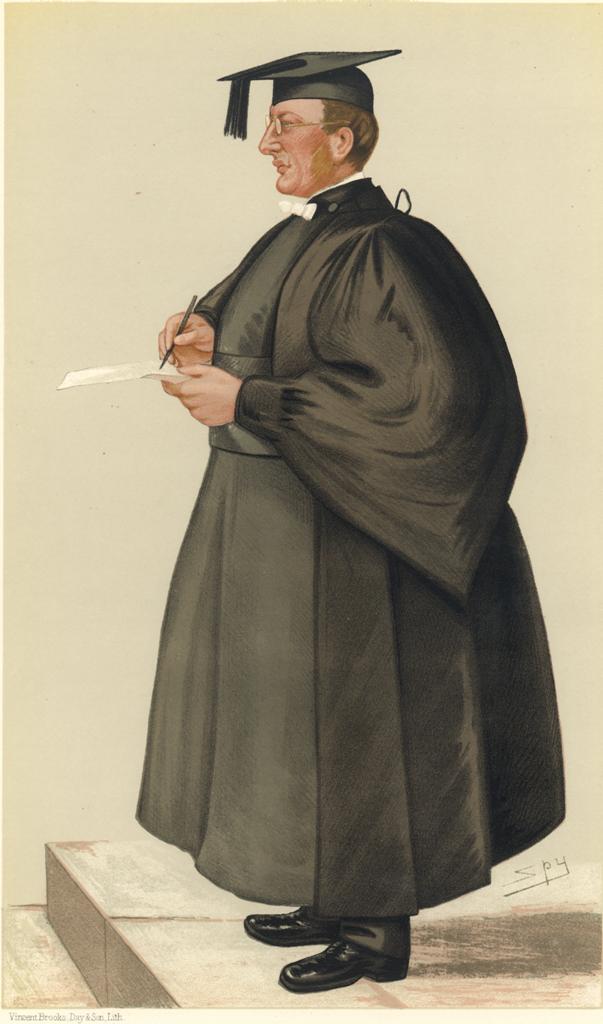
Edmond Warre, "The Head".
In Vanity Fair magazine, June 20, 1885. 
In Edmond Warre, D.D., C.B., C.V.O.: Sometime Headmaster and Provost of Eton College, by Charles Robert Leslie Fletcher (J. Murray, 1922), the Google Books copy, I found this passage.

"… Sir John Campbell (a Peninsular veteran who had married a Portuguese lady); he was not such a favourite with the children as Uncle Felix".

Because I don't have the actual book, just snippets, I can't easily see the whole page. I'm working on digging up interesting bits from the book for my next post.

Thursday, June 2, 2011

A wonderful newspaper clipping from 1835

This comes from the The Court Journal: Court circular and fashionable gazette of July 1835, page 503.


(It says: "A meeting took place on Wednesday evening at Battersea fields between R. J. Mackintosh Esq., attended by Major General Sir John Campbell and William Wallace, Esq. attended by Dr Richard Burke. The word having been given, Mr Mackintosh's pistol missed fire, and Mr Wallace fired in the air. A second fire took place without effect, and the parties, after a mutual explanation, shook hands.")

Summoned by loyalty, a soldier returns to the field, but for the wrong side

In 1824, Sir John Campbell found himself, at the age of 44, a widower with a 6-year-old daughter, and in mourning for his 3-year-old son. Before the year was out, he had resigned from the army, where he had distinguished himself in fighting in Portugal during the Peninsular Wars of the early 19th century. He and young Elizabeth were apparently living quietly in London. Then everything changed, again.

Sir John's late wife, Dona Maria Brigida do Faria e Lacerda, was Portuguese and I suspect from a good family. Sir John himself was friends with the royal family, or at least, part of it. By the late 1820s, Portugal was in a crisis over succession, which was a fight between one brother (Dom Pedro) favouring a constitutional monarchy and reform, and the other (Dom Miguel) wanting to stay with an absolute monarchy. It turned into a civil war.

The story of the Portuguese War of the Two Brothers is complicated. The highlights, for my purposes are simple enough, though.

British soldiers fought on both sides! Their leaders were officers who had been brothers in arms in the earlier Peninsular Wars. Men on both sides held knighthoods in both England and Portugal. All of them were at least notionally fighting illegally, according to the Foreign Enlistment Act.

To make things a little awkward for me in the research department, there were too many Campbells around, officers with the KCTS decoration, who served in the Peninsular Wars and possibly in this Portuguese civil war. Anyone who decides to study the story more closely will need to be cautious. I can only hope I am not getting the facts too confused.

There is no doubt that Sir John Campbell of my story, the man who eventually lives at 51 Charles Street, was at the head of the Miguelite forces, as they were called. He supported the absolutist cause whole-heartedly. On the other side were Admiral Sartorius and then Sir Charles Napier. Their respective forces were a mixture of English and Portuguese, and not professional soldiers, but what we might charitably call a motley crew.

A few brief glances at some of the debates in the House of Lords and the Commons after the war ended indicates that the British politicians were not in unanimous support of either side in the Portuguese war. Again, this is an over-simplification, but Sir John became something of a political football.

In the early days of the war, his side did well, but then the tide turned. Sir John was captured on board a ship (apparently leaving Portugal) with some allegedly incriminating papers. Papers or no, his side had lost. He became a prisoner of war.

This was an unpleasant imprisonment. Reading between the lines, I suspect there was a good deal of seeking revenge involved, because in some quarters the Miguelites had a reputation for being barbaric to their own prisioners. English visitors to Portugal after the war, in the early 1830s, reported seeing Sir John behind the bars of the prison compound.

His appeals to the English government for help went unanswered, on the basis that he was fighting in a foreign war on foreign soil, not in a British cause.

Why did he do it?

I've read that Sir John was a personal friend of Dom Miguel from his earlier time in Portugal, and I assume that the granting of the honour of KCTS, whenever that was, cemented that friendship. Sir John's politics must have been conservative, which mattered a great deal against the backdrop of the Reform movement in England.

He was held for at least nine months, much of which was apparently in solitary confinement. The degree of deprivation is in the eye of the beholder, but certainly it was a hard time, during which he was abandoned by his country.

I'm a little surprised that he was ever allowed to return to England. Having fought for the losing side in a battle that put British soldiers against each other, he could have been called treasonous without a huge stretch of the imagination.

I suspect what saved him was the fact that no one had clean hands.

By the time he returned to England in about 1834, his daughter was 16. He had been away from her for a few years (at least).

Here was a man who had spent much of his life achieving honour and glory as a soldier, only to end up disgraced. In the Commons debates, reference was made to his having a Portuguese wife (with the implication being that his loyalty wasn't to Britain), but no one pointed out that Maria Brigida had been dead for ten years.

He'd lost his wife and son, had hardly seen his daughter, had fought on a losing side and been imprisoned, and could probably never return to the country he must have come to love, Portugal.

He had reason to be a bitter and disappointed man, and maybe he was. Or, maybe he was so convinced of the rightness of his cause that he spent the rest of his life deploring the wrongs done to him. I don't know. The dictionary of biography says he lived a quiet life.

The quiet lasted until 1863, some 20 years after the civil war ended. It was then succeeded by that quiet which comes to us all, one day.

The first book, by Shaw, is about the War of Two Brothers. The other two books are from the Duke of Wellington's earlier experiences in Portugal. I have written before that Sir John Campbell was mentioned favourably in dispatches by Wellesley, late the Duke, but this may not be true, or it may be true but some of the mentions may refer to other Campbells. I post links to some of the books here in case anyone is interested in finding out more.


Saturday, May 28, 2011

Sir John Campbell, Knight Bachelor, and his wife Harriet Maria: what probate told me

In 1851 and 1861, Sir John Campbell and his wife Harriet Maria were  living at 51 Charles Street, Berkeley Square, London  with four servants in 1851 and two of the same plus two new ones in 1861.

My first impression was that this was a couple who had spent 50 or 60  years together. There was no mention of children in either census, but  as Sir John and Harriet were each born in about 1781, any children they  had may well have been married and gone by 1800 to 1810.

Sir John's presumably self-described occupation changed just a little  over the 10 years. He was a Knight Bachelor and a retired Lieutenant Colonel from the Army.

The fact that he was knighted gave me some hope of finding a formal and  detailed biography somewhere, and I wasn't disappointed. Sadly, the name  "John Campbell" is hardly rare. Even "Sir John Campbell" born around  1780 isn't unique. Throughout, I've had to be careful not to get mixed  up with other Sir John Campbells and other army officers of the same time, named Campbell.

Knowing that Sir John and Lady Campbell were each 80 years old in the 1861 census, it made sense to look for information about their respective deaths first. This is following the principle of working from the known to the unknown, a good basic research strategy.

Sir John Campbell: Information from probate

I am quite grateful that the National Probate Calendar for England is available online through Ancestry.com. This index lists all the grants to people who acted as executors and administrators of estates. It often gives a few good clues about where a person spent the latter part of their life, how much money they had at the end, and often identifies one or more close relatives.

A quick search for Sir John Campbell dying in 1861 or later turned up an entry in the Wills of 1864.

Instantly, I had a positive identification:
Sir John Campbell, Knight, late of 51 Charles Street;
and some new information:
  • He died 19 December 1863 at his home on Charles Street;
  • He was Knight Commander of the Order of the Tower and Sword of Portugal;
  • His effects were originally valued at under £8,000. In March 1865, the value was changed to under £10,000.
  • His executors were Richard Onslow of Wandsworth, Surrey, Esquire, and William Campbell Onslow of 28 Leinster Gardens, Middlesex, Esquire, a retired Lieutenant Colonel of Her Majesty's Indian Army.
This provided me with clues to last a month. Wonderful stuff!

It will be confusing to start into Lady Campbell's details here but don't worry, I did the same for her and will be back with more about her, too.

Friday, March 18, 2011

The Tithe Commission appoints Henry Fleming Assistant Tithe Commissioner for special purposes

1848

In late 1848, this announcement appeared.


From The Jurist, Vol. 11, Part 2

Henry was apparently only with the Tithe Commission for a short time and then began work for the Poor Law Board. It's also possible the two appointments overlapped. I know very little about the Tithe Commission, but one place where they appear to have had an interest in common with the Poor Law Commission and then the Poor Law Board was in the mapping of the parishes of England.

Thursday, March 17, 2011

Grandfather was a tyrant. Henry Fleming, Hunter Gowan and the Orange Lodge in Canada.

While on his father's side, Henry Fleming was descended from the Barons Slane, his mother's family were equally famous but also notorious.

Henry's grandfather was John Hunter Gowan II, often called Hunter Gowan.

Various descriptions of this man make him out to be a tyrant, a bully, and a violent leader. He was an anti-Catholic with a reputation for bloodshed.

One of his many children, Ogle Gowan, an illegitimate but recognized son, started the Orange Lodge in Canada. In The Orangeman: The Life and Times of Ogle Gowan, by Donald H. Akenson (, there is some description of Hunter Gowan's brutality back in Ireland.

There is also a paragraph mentioning how Ogle Gowan would use his half-brothers' and half-sisters' names when it suited him, even though he was "at daggers-drawn with his legitimate sisters and brothers".

"Catherine [Henry Fleming's mother], first married to a Sligo gentleman and also widowed had, as her second husband the Honourable John Fleming, third son and heir of Christopher, Lord Slane. A fine and noble man, Ogle was proud to say." (page 77)

I don't know if that's how Ogle said it, or if something has been lost in translation over the years, but my research to date indicates that Catherine married Captain Valentine Fleming, and that the descent from the Barons Slane was not quite as easily proven as Ogle might have suggested.

My other post for St. Patrick's Day today tells a bit more about the lost Baronetcy of Slane.

Sunday, March 6, 2011

Sending 13-year-old pauper children to work in the mills

For decades, Henry Fleming (our resident of No. 2 Charles Street in 1871) was a senior official with the Poor Law Board.

As Secretary in the early 1860s, he dealt with some interesting correspondence which now is online as the 1861 Sessional Papers of the House of Lords.

Link to the book of Sessional Papers

In the section entitled "Pauper Children", there is a series of letters, some with supporting appendices, dealing with proposals from some factory owners in England to take children from the workhouses as apprentices.

(The papers are not easily numbered, but using the on-page search function to find "pauper children", you should get to the right place.)

The children Henry Fleming corresponded about were to be apprenticed from age 13 to 17 as spinners in the textile mills. They were to work from 6 a.m. to 6 p.m. Monday through Friday, and until 1 p.m. on Saturday.

The entire report is heartbreaking in its details. There are the names and ages of individual children. Orphan. Father deserted, mother dead. Father believed in Australia, mother dead. Seven years in the workhouse to date. It goes on and on.

Some of the adult mill workers had no socks or shoes when the inspector called. The owner said it's because they preferred it that way. But, reported the inspector, "… when they go to meals and leave off work, they are all provided with factory clogs, which create no unusual clatter in the streets."

Henry Fleming, as Secretary to the Poor Law Board, may not have been a decision maker but may have had to brief the Board on the details of the apprenticeship proposals, at the least.

Henry was a man who spent his leisure time as a socialite, riding horses, gossiping, and generally hanging out with some of London's top society, and his working hours dealing with the details of caring for the destitute.

Friday, February 25, 2011

No. 2 Charles Street Berkeley Square, Mayfair, London, in 1871

The last seven posts, starting with

Thomas March of 1 Charles Street: One degree from Queen Victoria

have looked closely at the family who occupied No.1 Charles Street according to the 1871 census.

Charles Street runs from the south west corner of Berkeley Square, and from what I've seen, it was a pretty good neighbourhood back in 1871.

We continue the exploration with the second house on the street.  Here's the Google Maps image as it now is.


View Larger Map

And the current Google Street View picture, with No. 1 on the right (Thomas C. March house in 1871) and No. 2, the blue one, on the left.


View Larger Map


Link in case map isn't visible: 2 Charles Street, Mayfair, and the link to the Street View.

Living at No. 2, in 1871, the census says this.

No. 2: Henry Flemming, 59, unmarried, Civil Servant, Secretary of the Poor Law Board
1 Family, namely Henry himself.
2 Servants, James Austen, 50, and Martha Newman, 17, both unmarried.

Citation from Ancestry.co.uk: Class:  RG10; Piece:  102; Folio:  75; Page: 31; GSU roll:  838762.

There's a mention here on p. 522 of The British Medical Journal, May 23, 1868:

"IO. Mr. Flemming, Secretary of the Poor-law Board, acknowledges
on February 20th, I867, the receipt of Mr. Trevor's last letter."

The spelling of "Flemming", however, is not consistent in the records. In the majority of cases I've seen so far, it's been spelled with only one "m", "Fleming".

Henry Fleming was a rather interesting fellow, from another interesting family. This family will take us to the poorhouse and to the last gasps of the slave trade.


Our peek at the houses of Charles Street, Berkeley Square in 1871 began at No. 1: Thomas March of 1 Charles Street: One degree from Queen Victoria.


Before that, we started with the Stoker family: Bram Stoker, author of Dracula in public records: BMD (Birth, Marriage, Death).

Next: Who was Henry Fleming? A dandy? A heartless villain? Both? Neither? More history from Charles Street, Berkeley Square.

Sunday, February 20, 2011

What was Thomas Charles MARCH's Dracula number? Six degrees.

If you stayed with me through the exploration of the Thomas Charles MARCH family, not only do you deserve a medal, but you will already know what I mean by a Dracula number.


I'm playing Six Degrees of Separation with some of the residents of Charles Street, off Berkeley Square in London, in 1871, and determining how many degrees they are away from Queen Victoria (the Queen Victoria number) and from Bram STOKER the author of Dracula (the Dracula number).

By the way, I am using ALL CAPS for surnames here, a convention the police use a lot and family history writers sometimes, because the surname MARCH is too easily confused with the month.

Thomas Charles MARCH, of No. 1 Charles Street, Berkeley Square in 1871, has a Queen Victoria number of 1, having worked in the Royal Household for about 50 years in some high-ranking positions.

There are two connections I can point to between Thomas and Dracula, or at least, Bram.

Bram STOKER was an author of course, bu he was also a theatrical manager, and often described as the friend and manager of Sir Henry IRVING.

Sir Henry was the first actor to be knighted. The ceremony was on July 18, 1895 by Queen Victoria at Windsor. In an online archive of Sir Henry's correspondence, on the website henryirving.co.uk, there are two entries for correspondence between Sir Henry and Thomas Charles MARCH. In each, MARCH is described as Buckingham Palace paymaster, and his address is Board of Green Cloth, Buckingham Palace.

The first letter is from MARCH to IRVING, July 19, 1895. The catalogue description is: "Fees due to the Earl Marshall and British heralds upon knighthood are £26 and he asks for a cheque with the corrected or approved notice for the London Gazette."

The second letter, also from MARCH to IRVING, is dated July 26, 1895. "Receipt for £26 for knighthood fees to Sir Henry B. Irving."


So, from MARCH to IRVING to STOKER would give MARCH a Dracula number of 2, but I think we can do better.

The Lord Chamberlain's Office and the Theatre World of Victoria London

Let me not appear to have any kind of expertise in this subject whatsoever.

What I have inferred from cursory research is that the Lord Chamberlain's Office was in charge of making sure the theatre world ran properly. This included being the censor, and licensing plays as fit for public consumption.

Because of his long, active, and prominent involvement, and his leadership role in the theatre, Henry IRVING was frequently dealing with the Lord Chamberlain's Office, but not specifically with Thomas Charles MARCH. The job of censor appears to have belonged to the Comptroller within the Lord Chamberlain's Office.

From 1857 to 1901, Sir Spencer Cecil Brabazon PONSONBY-FANE was the Comptroller. It's not a long stretch of the imagination to suggest that, given this lengthy tenure, he and Thomas MARCH must have been well acquainted. Apparently both IRVING and STOKER were also well enough acquainted with the Comptroller that IRVING could instruct STOKER, on September 22, 1887 to seek advice from him ("have a chat") as an old friend, regarding some aggravation IRVING was experiencing from a third party, EARLTON(?). This is what the catalogue entry for a letter from IRVING to STOKER says:

"'We will proceed no further in this business' at least for the present. Come to [?] as soon as he [STOKER] can as Irving wants to hear the sound reasons of their wise old friend. Stoker should call at the Lord Chamberlain's Office, deliver the enclosed, and have a chat with Ponsonby Fane. The man Earlton(?) is playing a spiteful game and Irving wants to hear Sir Spencer's opinion of his tactics. Business great and all going well."

STOKER knew PONSONBY-FANE, again, giving MARCH a Dracula number of 2.

Is it too speculative to imagine that over the approximately 40 years in which they worked together, that PONSONBY-FANE and MARCH might have chatted with STOKER together? I am edging toward a #1, though not conclusively there yet.

Another nail in the coffin

One final tidbit has cropped up.

Bram STOKER's Dracula was published in 1897, and although it's his most famous book, it's not the only one he wrote. In 1911, a year before he died, his last book, The Lair of the White Worm, came out. (later made into a movie starting Amanda Donohoe and Hugh Grant. Who knew?) This is not exactly a vampire tale, but it has similar themes and strange supernatural elements. I have not read it. All I needed to see was this: the evil female supernatural creature is a woman (or so it seems) named Arabella MARCH.

Why? I don't know. Inconveniently, no one appears to have published a thesis on the topic, at least, not a thesis prominent enough for Google's attention. I offer these alternative reasons:

1. STOKER knew Sarah COOPER, who became Arabella MARCH, before marriage and thought she was enough of a schemer to be outed as such (years after her death and that of her husband);

2. STOKER knew Arabella MARCH, the daughter of Thomas and Sarah / Arabella, and thought she was a schemer who deserved to be outed as such;

3. STOKER knew either or both of the Arabella MARCHes and liked them, and used the name as a kind of ironic tribute, perhaps with permission;

4. STOKER didn't like Thomas Charles MARCH and took this low shot at him post-humously;

5. STOKER unconsciously chose the name of not just one, but two real persons he had either met or heard of; or

6. STOKER liked the name.

Provisionally, the real Arabellas (mother and daughter) get a Dracula score of 1 and so does Thomas. My game, my rules.


Thomas March is the first of many interesting people we will meet on Charles Street in 1871. His story starts with Thomas March of 1 Charles Street: One degree from Queen Victoria.


This article is one in an ongoing series, starting with Bram Stoker, author of Dracula in public records: BMD (Birth, Marriage, Death).

Next: Maud Gonne and Thomas Charles March and the English wine merchants who brought us port.

Friday, February 18, 2011

Six degrees of Queen Victoria: How the Thomas Charles MARCH family were connected

To recap, this is a potted history of the people at No. 1 Charles Street in 1871. If you would like to see a fuller version, just look in the post archives and you'll see a series of posts before this one, about the MARCH family.

Thomas Charles MARCH was a lifelong member of Queen Victoria's household staff, finishing his days as one of the top employees. One of the highlights of his career, in the easy-to-find public records, was representing the Royal Household in the procession bringing the Duke of Wellington's body from Kent to London for a state funeral.

Arabella S. MARCH, nee Sarah COOPER, born in Basingstoke, Hampshire, was a spinster with a child (Arabella) when she married Thomas (who was 20 years older) in 1867. How she came to have a child and a house on Sloane Street, and funds before she married Thomas, I don't know.

Arabella MARCH, the daughter, born in St. Luke's, Chelsea, didn't marry and disappeared from my view after selling the family's country home, Forest Lodge in Ashtead, Surrey, around 1901.

Thomas C. MARCH in the 1871 census is Thomas Charles MARCH, who matches a boy who died at the age of 8.

Not shown in the 1871 census, because he wasn't yet born, Reginald George MARCH was the youngest child I'm aware of, and the only one with children, again, as far as I know. He was born at Holmwood, Surrey in 1874, was, like his father, a Clerk in the Lord Chamberlain's office, fought in South Africa with Lord Paget's Horse, was married, and had at least two children. He enlisted for the First World War but does not appear to have seen active duty outside the United Kingdom.

The only person I'm aware of to carry on the MARCH name from this family was Reginald's son, Thomas Charles MARCH, who matches a gentleman who died in 1999 in Winchester.

I promised I would play Six Degrees of Separation, in two forms, for these people:

Six Degrees of Queen Victoria
and
Six Degrees of Dracula.

The Queen Victoria numbers are from 1 to 3.

1, Personal connection to Queen Victoria

Thomas Charles MARCH. Having served so long and in such important positions, I'm guessing he bumped into Her Majesty the Small Queen at least once in a while.

His son Reginald George MARCH, based on his position in the Lord Chamberlain's office, which could be a stretch. If not a 1, he is a 2, like the rest of the family.


2, Personal connection to a person with a Queen Victoria number of 1

Connected through Thomas Charles MARCH:

His wife Arabella S. MARCH
His daughter Arabella MARCH
His son Thomas C. MARCH.


Next: The Dracula scores.
That takes a bit of explaining.

Thomas March is the first of many interesting people we will meet on Charles Street in 1871. His story starts with Thomas March of 1 Charles Street: One degree from Queen Victoria.


This article is one in an ongoing series, starting with Bram Stoker, author of Dracula in public records: BMD (Birth, Marriage, Death).

Next: What was Thomas Charles March's Dracula number? Six degrees.

Tuesday, February 15, 2011

The end of Thomas Charles MARCH, his wife and children, apart from one important detail

The story so far:

Thomas Charles MARCH was a lifelong servant of the royal household during Queen Victoria's reign. He rose through the ranks of the Lord Chamberlain's office and by 1881 was Pay-master of the Royal Household. In sequential census returns, and in some of the other public records Ancestry.co.uk (Ancestry.com) has online, as well as what others have posted to the Web, I have been tracing Thomas and his family. The larger context started out with Bram STOKER and is explained in previous posts.

Bram Stoker and family in the 1881 English census

I looked more closely at the three servants:

Emma Barton, Bram Stoker's 15-year-old parlourmaid in 1881

Harriet Daw, Bram Stoker's Cook in 1881. The problem of a small spelling error

and

A brick wall: Elizabeth Jarrald, widow, Nurse to Bram Stoker's baby son in 1881.

Researching Elizabeth led me to the man I think she married:

Charles Jarrald, a well-placed servant indeed.

And then I got on to the MARCH family. I started using the common convention of putting surnames in ALL CAPS when I got to the MARCH family because it's too easy to confuse their name with the month of March.

Thomas Charles MARCH marries

Thomas Charles MARCH married Sarah COOPER in 1867. She brought with her a daughter, Arabella, who went by MARCH for the rest of her life. I think the daughter matches the Arabella MARCH who died in 1944. The probate records for 1944 are not yet available online but when I can get a look at them, I'll be interested to see the size of the fortune, or lack of it, that Arabella had when she died. I haven't found her in the census after 1891. I rather hope she was installed in a nice grace and favour apartment somewhere on the grounds of Buckingham Palace or even Hampton Court Palace for the rest of her days.

MARCH family life in the 1880s and later

Thomas and Sarah had two little brothers for Arabella, Thomas Charles MARCH, b. 1867, and Reginald George MARCH, b. 1874. Sadly, it appears little Thomas died at the age of 8.

By 1881, the MARCH family had decamped from London and were living at a very nice country house called Forest Lodge in Ashtead, Surrey.You can read a bit about it online, courtesy of the Surrey History Centre Archives and their website, Exploring Surrey's Past. They had probably left London for Surrey earlier, in the 1870s, as Reginald was born in Holmwood, Surrey in 1874, and the boy Thomas died, probably at Ashtead (Epsom registration district), in 1876. In 1881, Thomas (the father) was 61 and as mentioned, Pay-master of the Queen's Household.

Reginald was away at school in Cheltenham for the 1891 census. Thomas and the daughter Arabella were the only ones at Forest Lodge. This was Arabella's home until about three years after her father died (he died in 1898), when she sold it to Mr. Augustus MEYERS, who built a beautiful new home there.

Here is what the Surrey History Centre Archives' website says:

"In the early 19th century, the Haunch of Venison inn stood [where Forest Lodge was] but, during the 1860s, Henry Parsons converted it into a house, where, in 1871, he lived with a large household, including five servants. In the 1879 sale of Ashtead Park, Forest Lodge was bought for £3,700 on behalf of Lord Rosebery, although it was occupied at the time by Thomas C March, who held important positions in the royal household and who subsequently purchased the property. After his death, it was sold by his daughter, Arabella.

"Augustus Meyers purchased the estate in 1901 and lived there for nearly fifty years. Soon after he acquired the property, he built the present Forest Lodge, set well back from the road behind the site of the original inn, which had stood near the present entrance. The laying out of the grounds, including the demolition of the earlier house, had been completed by 1911."

Just a side-note about Lord Rosebery: he became Prime Minister of England. He was born in 1847 at No. 20, Charles Street, Berkeley Square. You may recall that Charles Street is what got us here. Thomas Charles MARCH lived at No. 1 in 1861.

There is a privately-published book called Photographic Views of Interior and Gardens, Forest Lodge, Ashtead, Surrey (1911) displayed on the website of Dumbarton Oaks Research Library, as part of an exhibit called "Of Making Many Books There is No End", that will close on March 31, 2011. Only the cover and one photograph (the one the cover picture is based on) are pictured on the website. The book was, I assume, prepared for Mr. MEYERS and depicts his new house, but that is just my best guess.

Sarah, Arabella's mother, died at Forest Lodge on July 7, 1888. Probate was granted, not to her husband, but to her spinster daughter Arabella MARCH on August 13, 1888. Sarah's will may have been set up to name Arabella as executrix because, with Thomas being about 20 years her elder, Sarah expected to outlive him. Sarah's personal estate was valued at £633/0/11.

Before her marriage to Thomas, the 1861 census showed Sarah living at 78 Sloane Street, Chelsea with her occupation being "House and Funded Proprietor". If that means she owned the house on Sloane Street, her fortune could have been considerable. Maybe that was invested in Forest Lodge, or maybe she was less wealthy than I imagine. Students of women's history can perhaps shed some light on the situation of a married woman's property in 1888. Did it remain hers, or did it become part of her husband's wealth upon marriage? I would only be guessing if I answered that question either way.


Link to the map and Google Street View of present day 78 Sloane Street. Dorchester Court, the modern red brick building on the left, is No. 77 through 81.The white building with the blue plaques is No. 76 (at the end close to Dorchester Court).


View Larger Map

It appears Thomas worked for Her Majesty's household until his death in 1898. His occupation in the 1891 census was "Secretary of Board of Green Cloth, Queen's Household".  Probate was granted to Reginald George MARCH, his son, who was then a Clerk to the Lord Chamberlain, on August 10, 1898.

Thomas's estate was valued at £15,387/0/8.
 
In the National Probate Calendar (Ref: England & Wales, National Probate Calendar (Index of Wills and Administrations),1861-1941 [database on-line]. Provo, UT, USA: Ancestry.com Operations Inc, 2010.Original data: Principal Probate Registry. Calendar of the Grants of Probate and Letters of Administration made in the Probate Registries of the High Court of Justice in England. London, England © Crown copyright.), Thomas was called Thomas Charles MARCH of 82 Ebury-street Middlesex C.B.

The C.B. was news to me, and stands for Companion of the The Most Honourable Order of the Bath, an honour bestowed by the Queen, to a senior civil servant. I have not been able to find details of when Thomas MARCH was given this honour.

Here is a link to the Google Street View and map for 82 Ebury-street (modern day; the black door on the right, with the two white squares of what looks like paper), in case the embedded map below is not visible. In the 1891 census, this was a lodging house kept by a widow. On census night the widow, two female servants, and one 21-year-old man, an Assistant Engineer in the navy, were there. I would guess this was a convenient place for Thomas MARCH to stay when in London on business, but not likely the sort of place his daughter would have moved to after selling Forest Lodge, if it catered to gentlemen civil servants.


View Larger Map

The two surviving family members, Arabella and Reginald appear, from the scanty collection of records I have seen, to have gone their separate ways. I don't mean they were estranged (who knows?), only that I haven't found them living together. I don't know where Arabella was between about 1901 (the sale of Forest Lodge) and 1944, her death.

I couldn't find Reginald in the 1901 census, either, but I did find a good explanation for that.

In 1914, when the First World War started, Reginald enlisted and gave his occupation as "motor lorry driver". That's rather unexpected for a Clerk to the Lord Chamberlain. The reason comes from his prior military service as a member of Lord Paget's Horse. This was a private regiment raised by Lord Paget to fight in the South African (aka Boer) War. It appears they were in South Africa on census night, 1901.

Lord Paget's Horse recruited gentlemen, and its official initials, PH, were jokingly said to stand for "Piccadilly Heroes".

Also mentioned in Reginald's First World War attestation papers is the fact that he was married, and the papers identify his wife and two children.

Reginald enlisted for "Short Service (One Year With the Colours)" on October 5, 1914 at the age of 30. As mentioned, his stated Trade or Calling was "Motor Lorry Driver". There was also a note "Speaks French fluently and German [illegible]". On November 17, 1917, he was discharged as being medically unfit for service, being over age. His service record shows that he was at Home (i.e., the UK), not sent abroad to fight.

He died in 1918, leaving £2,686/8/1 and naming his wife Ella and two solicitors as executors. It's possible Ella went on to remarry (I found a possible match in 1927 to John MAYLE) and also that she travelled to the U.S.A., and that she died in Winchester in 1973. I haven't tried to check those things out (too remote).

Of his children, the little bit of searching I did suggests (doesn't prove) that his daughter Marjorie Eva went to the U.S.A.  in 1930, for 3 months at the age of 19. The Marjorie MARCH who made that trip listed Mrs. MAYYLE [sic] as her mother on the ship's passenger list, so it all fits.

Reginald's son, Thomas Charles MARCH, matches the age and name of a gentleman who died in Winchester in 1999.

I have a little more information about Reginald that I won't put here; we've strayed rather far from Thomas, his father, already.

The MARCH family into which Thomas Charles MARCH the father was born did very well for themselves. I will show how well in a couple of posts from now.

Next time, I want to show the Six Degrees of Queen Victoria and Six Degrees of Dracula for the MARCH family we've looked at so far.


If you'd like to get these posts by email or RSS feed, just sign up using the buttons at the top right of the page. I would love to have you as a reader.

If you find these stories interesting, or have a question, please leave a comment. Let me know what catches your fancy and I'll find more.


Thomas March is the first of many interesting people we will meet on Charles Street in 1871. His story starts with Thomas March of 1 Charles Street: One degree from Queen Victoria.


This article is one in an ongoing series, starting with Bram Stoker, author of Dracula in public records: BMD (Birth, Marriage, Death).

Next: Six degrees of Queen Victoria: How the Thomas Charles March family were connected.

Sunday, February 13, 2011

Applying some Jane Austen logic to the marriage of Thomas Charles MARCH, Queen Victoria's Pay-master

I've been tracing the residents of Charles Street, Berkeley Square, based on the 1871 census. This started with the family of Bram STOKER, the author of Dracula, but it is not he who lived on Charles Street. I looked at the Bram Stoker household beginning in 1881, their first appearance in the English census, including examining the three women servants they had then. One, Elizabeth JARRALD, was a widow in 1881, but I found her (assumed) husband, Charles JARRALD in 1871. Even though Elizabeth and Charles were already married then, he, a 22-year-old servant, was at his employer's house on census night in 1871. That house was No. 27 Charles Street.

A little nosing around at who Charles's employer might be quickly showed that Charles Street was full of the upper classes, and so I decided to detour a bit away from the STOKERs, but don't worry, we will get back to Mr. Dracula eventually.

To keep the connection with Drac going, I am now playing two concurrent games:
Six Degrees of Queen Victoria
and
Six Degrees of Dracula.

The Head of the household at No. 1 Charles Street in the 1871 census, Thomas Charles MARCH, has a Queen Victoria number of 1. In a couple of posts from now, I'll reveal his Dracula number, which may surprise you.

Here's a recap of the 1871 census return for No. 1 Charles Street, from the post "Thomas March of 1 Charles Street: One degree from Queen Victoria".

At home: Thomas, age 50, married, Clerk Lord Chamberlain's Office, born in Marylebone.
His wife, Arabella S. MARCH, 32, born in Basingstoke.
Daughter, Arabella MARCH, 14, born in London St. Luke's Chelsea.
Son, Thomas C. MARCH, 3, born in London, St. George's [Hanover Square].

Thomas and Arabella got married some time after the 1861 census.

There are two little nits about the details of that marriage that make it less straightforward than at first appears.


The first is the name of Thomas's wife. In the 1871 census she is Arabella S. MARCH. I haven't found a matching lady named Arabella in a search for the marriage in the Ancestry.co.uk database (which searches the GRO Index and Free BMD, among others). The closest match I've found hangs on the "S": Sarah COOPER. Her age and place of birth match Arabella S. MARCH from the 1871 census, so I have provisionally assumed them to be the same person. There is no other likely Thomas Charles MARCH who matches nearly so closely.


Making assumptions in a blog post doesn't bother me. I try to make it very clear when I am crawling out on a limb, and I hope anyone reading this who has more information, will tell me. In the meantime I hate to let the absence of concrete proof of the facts get in the way of a good story.

The parish marriage register for the Parish of St. Thomas Portman Square (shown in Ancestry.com's database as St. Thomas Marylebone), shows:

On March 23, 1867, Thomas Charles MARCH, of full age, bachelor, Gentleman, of 93 Wimpole Street, Father's name Thomas MARCH (deceased), Gentleman,
married
Sarah COOPER, of full age, spinster, of 93 Wimpole Street, Father's name William COOPER, Gentleman.

The relevant entry is #425, found on page 213.
Source citation, from Ancestry: London Metropolitan Archives, Saint Thomas, Saint Marylebone, Register of marriages, P89/TMS, Item 006


The second nit is about Thomas's daughter, also called Arabella. On the one hand, she would appear to have been named for her mother, or at least, for the name her mother used in the 1871 census and later, but on the other hand, her birthdate is from the 1850s, before Thomas and Sarah (later Arabella) got married in 1867.

Arabella MARCH, Thomas's daughter in every census from 1871 on, was reportedly born around 1857, about 10 years before her parents' marriage.

I tend to assume, perhaps incorrectly, that single mothers in the second half of the 19th century were ostracized by society. Given that Thomas was working in the household more noted than any in English history for its propriety, Queen Victoria's, he is literally one of the last people I would expect to do anything remotely unconventional or scandalous.

This leads to some conclusions and assumptions.

The first assumption is that Arabella COOPER, later known as Arabella MARCH, the daughter, was born to married parents.

Given that, then the question is, were Sarah and Thomas actually married already when they got married in 1867? That seems unorthodox too, and is not my preferred hunch.

The second choice is that Arabella had either a different father, or a different mother, or both, and that one or both parents was either divorced or widowed. I rejected divorce, again because of propriety. It's something I wouldn't rule out conclusively, but it's low on the list of assumptions.

Then we consider: which parent was widowed? To conclude that either was, we have to assume that the marriage register was in error in calling the couple a bachelor and spinster. That does not seem likely, given who we're talking about, but I did look for evidence that either party had been married before. I found no evidence and decided to start a different line of inquiry: that Sarah gave birth to Arabella without marrying Arabella's father or that Sarah is Arabella's mother by adoption.

The out of wedlock birth seems almost inconceivable (pun intended and apologized for). Still, it was something I had to check out.

I searched in Ancestry.co.uk for a census return in 1861 for a woman born about 1838 in Basingstoke, with a daughter named Arabella.

Lo and behold, there emerged Sarah COOPER, unmarried, born about 1838 in Basingstoke with a daughter, Arabella COOPER, born about 1856 in St. Luke's Chelsea. Bingo! This doesn't prove Sarah to be Arabella's biological mother, but it does provide more clues. I would like to work more on the adoption hypothesis some time.

There is also the possibility that Sarah COOPER died and Thomas MARCH remarried between 1867 and 1871. I have not found evidence of such a death or such a remarriage, but my search has not been exhaustive. However, when Sarah COOPER, then Sarah MARCH died in 1888, the name under which probate was granted to her spinster daughter Arabella MARCH, was simply Sarah MARCH, no mention of Arabella.

And now, dear reader, cast your mind to the immortal words of Jane Austen as spoken by the insufferable Mrs. Bennet in Pride and Prejudice:

"It is a truth universally acknowledged, that a single man in possession of a good fortune, must be in want of a wife."

It is probably a truth also universally acknowledged, that a single woman in possession of a good fortune, must be in want of a husband.


Sarah COOPER in 1861 lived with her daughter and one servant (Louisa HIGGS, b. 1843 in Cornwall), at 78 Sloane Street, Chelsea. Her occupation was "House and Funded Proprietor". Ka-ching! I think I hear the sound of the accountant's mind jumping into gear as Thomas MARCH meets the younger, apparently wealthy woman with a daughter, Sarah COOPER.

Or am I too cynical?

Regardless of the reasons, Thomas and Sarah I think we can safely conclude, are the people I've identified as Thomas and Arabella in later years. How Sarah became a Sloane Ranger and the mother of Arabella, and whether Thomas was taking a social risk by marrying her, are questions upon which someone else can base a good Victorian romance, but that won't be me. Believe it or not, I have focus, and it's Thomas I came here to talk about today.

Thomas March is the first of many interesting people we will meet on Charles Street in 1871. His story starts with Thomas March of 1 Charles Street: One degree from Queen Victoria.


This article is one in an ongoing series, starting with Bram Stoker, author of Dracula in public records: BMD (Birth, Marriage, Death).

Next: The end of Thomas Charles March, his wife and children, apart from one important detail