This is part of my ongoing exploration of Charles Street, mainly in the 1871 census, though as it happens Sir John died in 1863.
I became curious about Sir John's wealth (or lack of it) and where it went after his death. One avenue I explored was the obvious one: his descendants.
Sir John's Portuguese wife and young son died when the boy was young, leaving only a daughter, Elizabeth Campbell (1818 - 1883). During Elizabeth's childhood, Sir John was away fighting on what ended up being the losing side of a revolution in Portugal. He then spent some more time there as a prisoner of war, while the British government washed their hands of him.
My suspicion is that Elizabeth may have been raised during his absence by one of Sir John's two sisters, Elizabeth. (His other sister, Marianna, died in 1810.) The two sisters had married two brothers from a very good family. Elizabeth married Reverend George Walton Onslow (1768 - 1844) and had at least 11 children.
One clue to the connection between this Elizabeth and Sir John that helped me find her and then figure out she was his sister, was that one of the children's name was Pitcairn Onslow. Sir John's mother was Annie Pitcairn and the name is a handy finding aid, especially when wallowing in a soup of Campbells.
Marianna Campbell married Reverend Arthur Onslow (1773 - 1851), and had at least three children. One, William Campbell Onslow, has the name of his grandfather (William Campbell) embedded in his own name.
In 1844, at the age of 26, Elizabeth (Sir John's daughter) married Edmond Sexten Pery Calvert (1797 - 1866), who would have been 46 or 47 by then. As far as I know, she was his first wife. The Calvert family has a lot of interesting connections, but I will try my hardest not to tell you about each and every one.
The Family Life of Elizabeth and Edmond Sexten Pery Calvert
It is hard for me to prove this next bit with absolute certainty, but my interpretation of the evidence suggests that E&E's first child was actually not one child, but twins. Felix Calvert was born in the spring of 1845 and died very soon thereafter. It looks like Felix had a twin sister, Frances Elise Calvert, who also died very soon after birth.
The next year, a daughter was born and survived. Her name was Frances Elizabeth Calvert, born on August 9, 1846. Her birth was noted in the magazine The Patrician.
A little brother, also called Felix, arrived on September 12, 1847. One source of confusion in researching family history is that names were recycled within the same generation, as this branch of the Calvert family demonstrates. In fact, from one generation to the next, the name "Felix" is very common in the Calverts and also in their relatives, the Ladbrokes.
The last child of Elizabeth Campbell Calvert of whom I'm aware of was Walter, born on September 4, 1849 at Charles Street. I would be on solid ground in suggesting this event happened at the home of Sir John Campbell and his second wife, Harriet Maria (nee Norie), at 51 Charles Street.
Frances Elise died before she was 10 years old, in the spring of 1856.
Her two brothers, however, did live quite long lives. Their father, Edmond Sexten Pery Calvert, died in 1866 at 68. Felix was 19, Walter 17 and their mother, Elizabeth 48 when that happened. She did not remarry.
For much of her life, Elizabeth lived with her son Felix. She died at 65 in late December of 1883. Felix lived on, farming the Calvert estate at Furneux Pelham in Hertfordshire until his death, unmarried, at age 62. He was a Justice of the Peace.
The youngest, Walter Campbell Calvert, went into the military and reached the rank of Captain in the 5th Dragoon Guards. He died in 1932, having had the longest life of them all, at 82. He too appears to have been unmarried and as far as I know, left no children.
And thus the line of Sir John Campbell, KCTS, expired. There are many collateral descendants – nephews, nieces, cousins, and so on – but no one who traces back to Sir John directly.
What happened to the family fortune?
The question to ask before that one is, "Was there a family fortune?" I have looked into this and the answers were surprising. That's for another day, though.
Showing posts with label genealogy. Show all posts
Showing posts with label genealogy. Show all posts
Saturday, June 25, 2011


Monday, June 20, 2011
Why you should keep on digging when researching family history
I had the birth, marriage, and death information for Sir John Campbell, KCTS some time ago. Why keep going?
There are a few reasons, but here is one of them: to learn what kind of man he was.
I've made inferences, which is really all I can do, given the lack of direct evidence about the man. However, there are a few eyewitnesses who described him as a soldier (Sir Arthur Wellesley, later the Duke of Wellington, commended him in his reports of battles in Portugal), as a prisoner of war in Portugal, and even in the House of Lords, he was a topic of conversation, albeit perhaps as more of a political football than as an individual.
None of this shed light on his home life, which is what I hoped to find out about as I continued the research.
Through a lot of persistent searching for anything about him, I thought I had found pretty much all I could in terms of books or articles mentioning him specifically, to the extent that these appear online. That will change with time, and there's a lesson: go back in a year, and then in another year, and another, until you are satisfied. More information becomes available all the time. Never close the door.
I also learned the value of tracking relatives beyond the immediate family. Well, "learned" isn't really the right word. "Proved" might be closer.
The best nugget came from searching his name in conjunction with the name of a house, Hunsdon House. How did I know to do that search? Because I traced Sir John's daughter, Elizabeth, his only surviving child. She married into the Calvert family, and lived for a time at their property, Hunsdon House.
Pushing further into the Calverts revealed two interesting sources: the published memoirs of Elizabeth's mother-in-law, Lady Frances Calvert (nee Pery), and the fact that one of Elizabeth's nephews became a very well-known public figure. He was Edmond Warre (1837 to 1920) who is remembered as a famous oarsman for Oxford and a long-time master and then Headmaster (1880 to 1909) of Eton College.
In Edmond Warre, D.D., C.B., C.V.O.: Sometime Headmaster and Provost of Eton College, by Charles Robert Leslie Fletcher (J. Murray, 1922), the Google Books copy, I found this passage.
"… Sir John Campbell (a Peninsular veteran who had married a Portuguese lady); he was not such a favourite with the children as Uncle Felix".
Because I don't have the actual book, just snippets, I can't easily see the whole page. I'm working on digging up interesting bits from the book for my next post.
There are a few reasons, but here is one of them: to learn what kind of man he was.
I've made inferences, which is really all I can do, given the lack of direct evidence about the man. However, there are a few eyewitnesses who described him as a soldier (Sir Arthur Wellesley, later the Duke of Wellington, commended him in his reports of battles in Portugal), as a prisoner of war in Portugal, and even in the House of Lords, he was a topic of conversation, albeit perhaps as more of a political football than as an individual.
None of this shed light on his home life, which is what I hoped to find out about as I continued the research.
Through a lot of persistent searching for anything about him, I thought I had found pretty much all I could in terms of books or articles mentioning him specifically, to the extent that these appear online. That will change with time, and there's a lesson: go back in a year, and then in another year, and another, until you are satisfied. More information becomes available all the time. Never close the door.
I also learned the value of tracking relatives beyond the immediate family. Well, "learned" isn't really the right word. "Proved" might be closer.
The best nugget came from searching his name in conjunction with the name of a house, Hunsdon House. How did I know to do that search? Because I traced Sir John's daughter, Elizabeth, his only surviving child. She married into the Calvert family, and lived for a time at their property, Hunsdon House.
Pushing further into the Calverts revealed two interesting sources: the published memoirs of Elizabeth's mother-in-law, Lady Frances Calvert (nee Pery), and the fact that one of Elizabeth's nephews became a very well-known public figure. He was Edmond Warre (1837 to 1920) who is remembered as a famous oarsman for Oxford and a long-time master and then Headmaster (1880 to 1909) of Eton College.
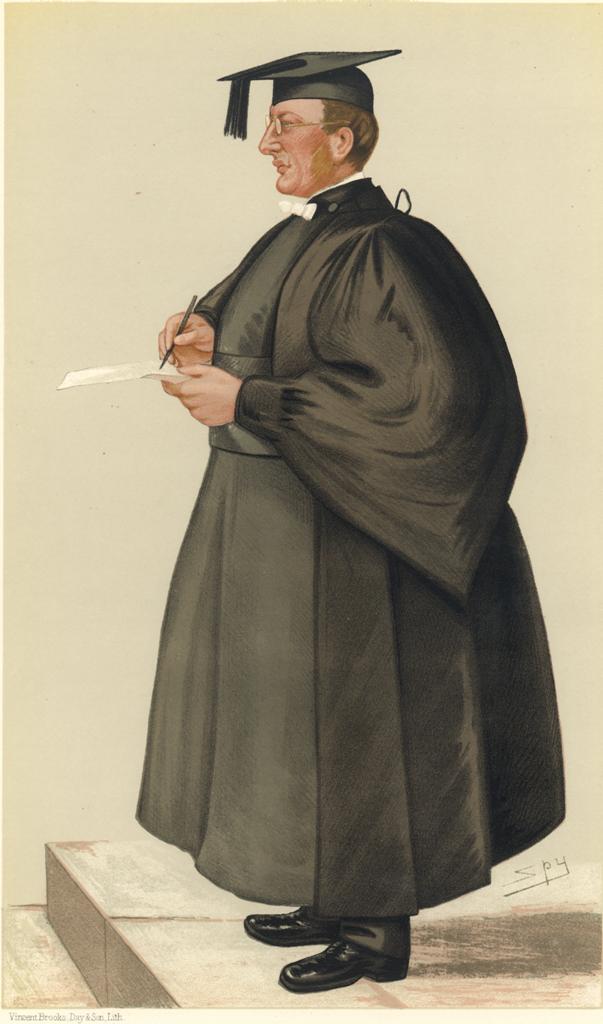 | |
| Edmond Warre, "The Head". In Vanity Fair magazine, June 20, 1885. |
"… Sir John Campbell (a Peninsular veteran who had married a Portuguese lady); he was not such a favourite with the children as Uncle Felix".
Because I don't have the actual book, just snippets, I can't easily see the whole page. I'm working on digging up interesting bits from the book for my next post.
Saturday, May 28, 2011
Sir John Campbell, Knight Bachelor, and many directions for research
Yes, I know I promised something about Queen Victoria's god-daughter and I will deliver, but not yet.
I found a story that's held my attention for a couple of weeks now, and I hope you will find it interesting too. I'll have to tell it in installments I'm afraid. So far there have been elements of:
I've started putting together a spreadsheet from 1841 to 1901, showing the names of the inhabitants, in all 7 censuses, for each house. This has been illuminating and useful even with just half a dozen or so houses completed, so I will keep going.
Today's story introduces Sir John Campbell, a knight and an army veteran.
51 Charles Street, 1851
From the census, reference:
Class HO107
Piece 1476
Folio 364
Page 18
GSU Roll 87799.
On Ancestry.com, the page is found in the 1851 English Census at:
Middlesex >St. George Hanover Square >May Fair > District 17 > 18.
John Campbell, Head, married, age 70. Knight Bachelor late Lt Col 75 [indecipherable]. Born Kent, Chatham.
Harriet Maria Campbell, Wife, married, age 70. No occupation shown. Born Middlesex, Aldgate.
Servants:
Anne Sutton, Servant, unmarried, age 45. Cook. Born Norfolk, Aylsham.
Sarah Loal, Servant, unmarried, age 31. Ladies Maid. Born Northampton, Nassington.
Sarah Calligan, Servant, unmarried, age 35. Housemaid. Born Middlesex, Hackney.
Joseph Attersall, Servant, unmarried, age 22. Footman. Born Lincolnshire, Fiskerton.
The Campbells are at the same place ten years later. Two of the four servants have remained with them. I take this as a sign that someone was a decent employer, when the servants stay for a long time. Of course, there were other reasons to leave a household, even when the employer was good. I make fewer inferences about people leaving than about them staying.
51 Charles Street, 1861
From the census, reference:
Class RG9
Piece 46
Folio 53
Page 39
GSU Roll 542563.
On Ancestry.com, the page is found in the 1861 English Census at:
Middlesex >St. George Hanover Square >May Fair > District 15 > 39.
Sir John Campbell, Knt. Head, married, age 80. Formerly Lieut Colonel - Retired from the Army Inf. Knight Bachelor. Born Kent, Chatham.
Harriet Marie Campbell, Wife, married, age 80. No occupation shown. Born Middlesex,City of London, St. Botolphs.
Servants:
Sarah Loal, Servant, unmarried, age 41. Ladies Maid. Born Northampton, Nassington.
Joseph Attersall, Servant, unmarried, age 30. Butler and Valet. Born Lincolnshire, Fiskerton.
Henrietta Chandler, unmarried, age 32. Cook. Born Norfolk, Northwold.
Ellen Smith, unmarried, age 27. Housemaid. Born Bushy, Hertfordshire.
Given these two fixed points, we can start to explore some dimensions of the Campbells' lives.
I found a story that's held my attention for a couple of weeks now, and I hope you will find it interesting too. I'll have to tell it in installments I'm afraid. So far there have been elements of:
- the history of the English in Portugal in the early 1800s
- the patterns of marrying and remarrying within a certain social group and class
- the way military officers stick together
- the way women are so poorly represented in historical records compared to men
- charming portraiture from the mid-1800s
- a family with some notable artists
- another family with a knack for marrying well
- the fate of a foreign bride
- money and how it moves between generations
- and lots more.
I've started putting together a spreadsheet from 1841 to 1901, showing the names of the inhabitants, in all 7 censuses, for each house. This has been illuminating and useful even with just half a dozen or so houses completed, so I will keep going.
Today's story introduces Sir John Campbell, a knight and an army veteran.
51 Charles Street, 1851
From the census, reference:
Class HO107
Piece 1476
Folio 364
Page 18
GSU Roll 87799.
On Ancestry.com, the page is found in the 1851 English Census at:
Middlesex >St. George Hanover Square >May Fair > District 17 > 18.
John Campbell, Head, married, age 70. Knight Bachelor late Lt Col 75 [indecipherable]. Born Kent, Chatham.
Harriet Maria Campbell, Wife, married, age 70. No occupation shown. Born Middlesex, Aldgate.
Servants:
Anne Sutton, Servant, unmarried, age 45. Cook. Born Norfolk, Aylsham.
Sarah Loal, Servant, unmarried, age 31. Ladies Maid. Born Northampton, Nassington.
Sarah Calligan, Servant, unmarried, age 35. Housemaid. Born Middlesex, Hackney.
Joseph Attersall, Servant, unmarried, age 22. Footman. Born Lincolnshire, Fiskerton.
The Campbells are at the same place ten years later. Two of the four servants have remained with them. I take this as a sign that someone was a decent employer, when the servants stay for a long time. Of course, there were other reasons to leave a household, even when the employer was good. I make fewer inferences about people leaving than about them staying.
51 Charles Street, 1861
From the census, reference:
Class RG9
Piece 46
Folio 53
Page 39
GSU Roll 542563.
On Ancestry.com, the page is found in the 1861 English Census at:
Middlesex >St. George Hanover Square >May Fair > District 15 > 39.
Sir John Campbell, Knt. Head, married, age 80. Formerly Lieut Colonel - Retired from the Army Inf. Knight Bachelor. Born Kent, Chatham.
Harriet Marie Campbell, Wife, married, age 80. No occupation shown. Born Middlesex,City of London, St. Botolphs.
Servants:
Sarah Loal, Servant, unmarried, age 41. Ladies Maid. Born Northampton, Nassington.
Joseph Attersall, Servant, unmarried, age 30. Butler and Valet. Born Lincolnshire, Fiskerton.
Henrietta Chandler, unmarried, age 32. Cook. Born Norfolk, Northwold.
Ellen Smith, unmarried, age 27. Housemaid. Born Bushy, Hertfordshire.
Given these two fixed points, we can start to explore some dimensions of the Campbells' lives.
Wednesday, April 20, 2011
4 Charles Street, Berkeley Square, in 1871
A new house, fresh blood and more stories. The first three households were reasonably different from each other. This one adds a new dimension: gasp, the man is in trade.
Present at 4 Charles Street on census night in 1871
George Drew, Head, Married, 62. Master Grocer employing 2 men and 2 boys. Born Wimbledon, Surrey.
Mary A Drew, Wife, Married, 53. (No occupation given). Born Westminster, Middlesex.
George W. Drew, Son, Unmarried, 20. (No occupation given). Born Westminster, Middlesex.
Emma M. Drew, Daughter, Unmarried, 18. (No occupation given). Born Westminster, Middlesex.
Ellen R. Drew, Daughter, Unmarried, 16. Scholar. Born Westminster, Middlesex.
Charles B. Drew, Son, Unmarried, 14. Scholar. Born Westminster, Middlesex.
Jane Wadie, Sister, Widow, 57. Annuitant. Born Wimbledon, Surrey.
Sarah Riddle, Servant, Unmarried, 19. General Servant. (Place of birth not shown).
G.R.C. Harris (male), Lodger, Unmarried, 20. Undergraduate. Born St Anns, Trinidad.
A picture of the house today, from Google Maps Street View.
Link for those who can't see the picture.
View Larger Map
 |
| 1871 census: 4 Charles Street. Source: |
George Drew, Head, Married, 62. Master Grocer employing 2 men and 2 boys. Born Wimbledon, Surrey.
Mary A Drew, Wife, Married, 53. (No occupation given). Born Westminster, Middlesex.
George W. Drew, Son, Unmarried, 20. (No occupation given). Born Westminster, Middlesex.
Emma M. Drew, Daughter, Unmarried, 18. (No occupation given). Born Westminster, Middlesex.
Ellen R. Drew, Daughter, Unmarried, 16. Scholar. Born Westminster, Middlesex.
Charles B. Drew, Son, Unmarried, 14. Scholar. Born Westminster, Middlesex.
Jane Wadie, Sister, Widow, 57. Annuitant. Born Wimbledon, Surrey.
Sarah Riddle, Servant, Unmarried, 19. General Servant. (Place of birth not shown).
G.R.C. Harris (male), Lodger, Unmarried, 20. Undergraduate. Born St Anns, Trinidad.
A picture of the house today, from Google Maps Street View.
Link for those who can't see the picture.
View Larger Map
Monday, March 21, 2011
Whoops! Forgot to give the Flea his Queen Victoria and Dracula numbers!
Back to our game of Six Degrees.
Henry Fleming -> Disraeli, Palmerston, Gladstone, others -> HM Queen Victoria
A Queen Victoria number of 2.
I suspect that is as high as he got.
Henry Fleming -> introduced the beauty, Virginia Pattle to the painter, George Frederic Watts at a party at Holland House -> Watts later married Ellen Terry, the actress -> Ellen Terry was Henry Irving's partner and leading lady, and of course would have known Bram Stoker, Irving's business manager and friend.
So far, a Dracula number of 3.
Henry Fleming -> spent many Sunday afternoons gossiping at the home of Thomas Carlyle, the writer -> Carlyle lived on Cheyne Walk, as did the Stokers, (though that doesn't prove they knew each other)
Possible Dracula number of 2.
I'd love to speculate about Henry Fleming and Oscar Wilde knowing each other, as they did have a few things in common, and Wilde was a friend of Stoker, but it would only be speculation.
The Stokers moved to London in the late 1870s, and Henry died in 1876, so it's not likely they crossed paths.
Henry Fleming -> Disraeli, Palmerston, Gladstone, others -> HM Queen Victoria
A Queen Victoria number of 2.
I suspect that is as high as he got.
Henry Fleming -> introduced the beauty, Virginia Pattle to the painter, George Frederic Watts at a party at Holland House -> Watts later married Ellen Terry, the actress -> Ellen Terry was Henry Irving's partner and leading lady, and of course would have known Bram Stoker, Irving's business manager and friend.
So far, a Dracula number of 3.
Henry Fleming -> spent many Sunday afternoons gossiping at the home of Thomas Carlyle, the writer -> Carlyle lived on Cheyne Walk, as did the Stokers, (though that doesn't prove they knew each other)
Possible Dracula number of 2.
I'd love to speculate about Henry Fleming and Oscar Wilde knowing each other, as they did have a few things in common, and Wilde was a friend of Stoker, but it would only be speculation.
The Stokers moved to London in the late 1870s, and Henry died in 1876, so it's not likely they crossed paths.
Sunday, March 20, 2011
A goodbye, for now, to Henry Fleming
I have so loved researching Henry Fleming, who lived at No. 2, Charles Street, Berkeley Square, London, in 1871.
But it's time to say goodbye, at least for now, because I want to move on down the street.
Here are a few things I'll mention before leaving.
1. Henry's mother, Catherine, was the daughter of a famous, or infamous, Irish Protestant leader, John Hunter Gowan II (aka Hunter Gowan). One of her half-brothers was Ogle Gowan, who started the Orange Lodge in Canada.
2. Henry's father was Captain Valentine Fleming, from Tuam, County Galway, in Ireland. He was a captain in the British 9th Regiment of Foot. He was Catherine's second husband, and died in 1824 when his four children were roughly aged 10 to 14. I have a copy of his will.
3. All three Fleming brothers, James, Valentine, and Henry, were apparently educated in Ireland, possibly all at Trinity College, Dublin, and all three were lawyers, though Henry didn't continue with the practice very long.
4. Although I have traced each of the brothers, I don't know what happened to their mother and their sister, Emma.
5. A James Fleming, who had a brother named Henry, both of Dublin, petitioned the House of Lords in the late 1820s to claim the title "Baron of Slane". I think this may have been the brothers, before they moved from Ireland to London. They did not succeed.
6. James became a QC, Chancellor of the Palatinate of Durham, and an official for the West Indies. His wife was Julia Mary Canning, and I suspect she had a reasonably impressive pedigree herself. Their children all had the middle name "Francis", except the eldest, who was named "Francis" as his first name.
7. Henry's nephew, James's son Francis Fleming had a distinguished career in the foreign service, and was variously governor of Antigua, and a senior official (possibly also governor) of Hong Kong, Sierra Leone, and Mauritius.
8. Another nephew from the same family, Baldwyn Francis Fleming, followed his uncle Henry into the Poor Law Board and then the Local Government Board. My first impression is that he was a good civil servant who cared about the people he was responsible for.
9. Henry's brother, Valentine, became Sir Valentine, and was the Chief Justice of Tasmania for some time, before returning to England where eventually he died in retirement in Surrey.
10. Henry had kind of a double life: civil servant and socialite. As a civil servant, he was described in none-too-glowing terms, varying from boring through to incompetent, depending upon who was saying it, and when in his career they were commenting. I have yet to see a comment describing him as dynamic and indispensable, and yet he was a top-level official for decades.
11. In his social life, Henry knew everyone, and it is in this capacity that the real interest lies. He mingled with lords, ladies, writers, members of Parliament, Prime Ministers Disraeli and Palmerston, and probably Gladstone too, and his role was to spread strategically-placed gossip. This is the part of Henry Fleming's life most deserving of scholarly study.
I have collected a number of links to references to Henry Fleming. Though I haven't seen any one work devoted to the man himself, it is rather surprising just how many 19th century Londoners mention him in their own memoirs and accounts of the day.
He died in 1876, still employed by the Local Government Board, still living at No. 2, Charles Street, Berkeley Square, and on the same day as Lady Stanley, thus departing life in the same manner as he had lived it: in the penumbra of the upper class.
But it's time to say goodbye, at least for now, because I want to move on down the street.
Here are a few things I'll mention before leaving.
1. Henry's mother, Catherine, was the daughter of a famous, or infamous, Irish Protestant leader, John Hunter Gowan II (aka Hunter Gowan). One of her half-brothers was Ogle Gowan, who started the Orange Lodge in Canada.
2. Henry's father was Captain Valentine Fleming, from Tuam, County Galway, in Ireland. He was a captain in the British 9th Regiment of Foot. He was Catherine's second husband, and died in 1824 when his four children were roughly aged 10 to 14. I have a copy of his will.
3. All three Fleming brothers, James, Valentine, and Henry, were apparently educated in Ireland, possibly all at Trinity College, Dublin, and all three were lawyers, though Henry didn't continue with the practice very long.
4. Although I have traced each of the brothers, I don't know what happened to their mother and their sister, Emma.
5. A James Fleming, who had a brother named Henry, both of Dublin, petitioned the House of Lords in the late 1820s to claim the title "Baron of Slane". I think this may have been the brothers, before they moved from Ireland to London. They did not succeed.
6. James became a QC, Chancellor of the Palatinate of Durham, and an official for the West Indies. His wife was Julia Mary Canning, and I suspect she had a reasonably impressive pedigree herself. Their children all had the middle name "Francis", except the eldest, who was named "Francis" as his first name.
7. Henry's nephew, James's son Francis Fleming had a distinguished career in the foreign service, and was variously governor of Antigua, and a senior official (possibly also governor) of Hong Kong, Sierra Leone, and Mauritius.
8. Another nephew from the same family, Baldwyn Francis Fleming, followed his uncle Henry into the Poor Law Board and then the Local Government Board. My first impression is that he was a good civil servant who cared about the people he was responsible for.
9. Henry's brother, Valentine, became Sir Valentine, and was the Chief Justice of Tasmania for some time, before returning to England where eventually he died in retirement in Surrey.
10. Henry had kind of a double life: civil servant and socialite. As a civil servant, he was described in none-too-glowing terms, varying from boring through to incompetent, depending upon who was saying it, and when in his career they were commenting. I have yet to see a comment describing him as dynamic and indispensable, and yet he was a top-level official for decades.
11. In his social life, Henry knew everyone, and it is in this capacity that the real interest lies. He mingled with lords, ladies, writers, members of Parliament, Prime Ministers Disraeli and Palmerston, and probably Gladstone too, and his role was to spread strategically-placed gossip. This is the part of Henry Fleming's life most deserving of scholarly study.
I have collected a number of links to references to Henry Fleming. Though I haven't seen any one work devoted to the man himself, it is rather surprising just how many 19th century Londoners mention him in their own memoirs and accounts of the day.
He died in 1876, still employed by the Local Government Board, still living at No. 2, Charles Street, Berkeley Square, and on the same day as Lady Stanley, thus departing life in the same manner as he had lived it: in the penumbra of the upper class.
Friday, March 18, 2011
The Tithe Commission appoints Henry Fleming Assistant Tithe Commissioner for special purposes
1848
In late 1848, this announcement appeared.

From The Jurist, Vol. 11, Part 2
Henry was apparently only with the Tithe Commission for a short time and then began work for the Poor Law Board. It's also possible the two appointments overlapped. I know very little about the Tithe Commission, but one place where they appear to have had an interest in common with the Poor Law Commission and then the Poor Law Board was in the mapping of the parishes of England.
In late 1848, this announcement appeared.
From The Jurist, Vol. 11, Part 2
Henry was apparently only with the Tithe Commission for a short time and then began work for the Poor Law Board. It's also possible the two appointments overlapped. I know very little about the Tithe Commission, but one place where they appear to have had an interest in common with the Poor Law Commission and then the Poor Law Board was in the mapping of the parishes of England.
Thursday, March 17, 2011
Clippings about the lost Baronetcy of Slane
From: A genealogical history of the dormant, abeyant, forfeited, and extinct peerages of the British empire. Sir Bernard Burke, publisher: Harrison, 1866, at pp. 217-218.
This copy provided by Google books.


A more modern book, A Genealogical History of the Barons Slane, by Lawrence F. Fleming (published by the author, 2008), mentions that James Fleming of Dublin and George Bryan of Jenkinstown, took their claims to the baronetcy to the House of Lords in 1828. Lawrence Fleming says later Flemings owe a debt of gratitude to these two, "for their rather foolish claims to nobility". He believes the evidence brought in opposition was conclusive proof that the claims were not well-founded, but by assembling the evidence for the House of Lords, the claimants unknowingly protected it from destruction a hundred years later, when the Four Courts building in Dublin was burned, taking so many historical documents with it.
This copy provided by Google books.
A more modern book, A Genealogical History of the Barons Slane, by Lawrence F. Fleming (published by the author, 2008), mentions that James Fleming of Dublin and George Bryan of Jenkinstown, took their claims to the baronetcy to the House of Lords in 1828. Lawrence Fleming says later Flemings owe a debt of gratitude to these two, "for their rather foolish claims to nobility". He believes the evidence brought in opposition was conclusive proof that the claims were not well-founded, but by assembling the evidence for the House of Lords, the claimants unknowingly protected it from destruction a hundred years later, when the Four Courts building in Dublin was burned, taking so many historical documents with it.
Grandfather was a tyrant. Henry Fleming, Hunter Gowan and the Orange Lodge in Canada.
While on his father's side, Henry Fleming was descended from the Barons Slane, his mother's family were equally famous but also notorious.
Henry's grandfather was John Hunter Gowan II, often called Hunter Gowan.
Various descriptions of this man make him out to be a tyrant, a bully, and a violent leader. He was an anti-Catholic with a reputation for bloodshed.
One of his many children, Ogle Gowan, an illegitimate but recognized son, started the Orange Lodge in Canada. In The Orangeman: The Life and Times of Ogle Gowan, by Donald H. Akenson (, there is some description of Hunter Gowan's brutality back in Ireland.
There is also a paragraph mentioning how Ogle Gowan would use his half-brothers' and half-sisters' names when it suited him, even though he was "at daggers-drawn with his legitimate sisters and brothers".
"Catherine [Henry Fleming's mother], first married to a Sligo gentleman and also widowed had, as her second husband the Honourable John Fleming, third son and heir of Christopher, Lord Slane. A fine and noble man, Ogle was proud to say." (page 77)
I don't know if that's how Ogle said it, or if something has been lost in translation over the years, but my research to date indicates that Catherine married Captain Valentine Fleming, and that the descent from the Barons Slane was not quite as easily proven as Ogle might have suggested.
My other post for St. Patrick's Day today tells a bit more about the lost Baronetcy of Slane.
Henry's grandfather was John Hunter Gowan II, often called Hunter Gowan.
Various descriptions of this man make him out to be a tyrant, a bully, and a violent leader. He was an anti-Catholic with a reputation for bloodshed.
One of his many children, Ogle Gowan, an illegitimate but recognized son, started the Orange Lodge in Canada. In The Orangeman: The Life and Times of Ogle Gowan, by Donald H. Akenson (, there is some description of Hunter Gowan's brutality back in Ireland.
There is also a paragraph mentioning how Ogle Gowan would use his half-brothers' and half-sisters' names when it suited him, even though he was "at daggers-drawn with his legitimate sisters and brothers".
"Catherine [Henry Fleming's mother], first married to a Sligo gentleman and also widowed had, as her second husband the Honourable John Fleming, third son and heir of Christopher, Lord Slane. A fine and noble man, Ogle was proud to say." (page 77)
I don't know if that's how Ogle said it, or if something has been lost in translation over the years, but my research to date indicates that Catherine married Captain Valentine Fleming, and that the descent from the Barons Slane was not quite as easily proven as Ogle might have suggested.
My other post for St. Patrick's Day today tells a bit more about the lost Baronetcy of Slane.
The Lost Baronetcy of Slane. Maybe you are an Irish noble and don't know it.
Happy St. Patrick's Day! In honour of the occasion I am going to post two stories connecting Henry Fleming to Ireland.
Henry Fleming's story is in turn part of a larger history and genealogy project, tracing the residents of Charles Street, Berkeley Square, London, from the 1871 census.
The Charles Street Series
Flemings and the lost Baronetcy of Slane
There is a Slane Castle and a title, Baron Slane, attached to a little corner of Ireland near Dublin.
(U2 played there in 2001.)
I expect the castle is well taken care of, but the title is going begging for want of a suitable heir.
That's not for trying.
In the 1830s, one George Bryan petitioned the House of Lords in England to have himself recognized as the lawful inheritor of the title. It was a very complex claim, and the Lords referred it to a special committee. After five years of investigation, the decision was that the claim had not been made out, but Mr. Bryan was free to come back if further evidence surfaced.
Bryan's claim was opposed by a James Fleming and his brother Henry. I have seen references to these two being of Dublin, but also to James Fleming being one of Her Majesty's counsel. I have two theories.
1. The Fleming claim was made by James Fleming, a brother of Captain Valentine Fleming, and thus the uncle of James Fleming QC and his brother Henry of No. 2 Charles Street.
or
2. The Fleming claim was made by James Fleming, QC, when he was a student or a recent graduate of Trinity College, Dublin, and thus living there, and that the Henry referred to was Henry of No. 2 Charles Street.
The latter theory seems more plausible because of the ripple effect this claim to the Baronetcy of Slane had in the generation to which James Fleming, QC, Henry of No. 2 Charles Street, and their brother Sir Valentine Fleming belonged. There is no doubt that this is the right family, it's just a question of which generation went to the House of Lords.
Sir Valentine named his second son Henry Slane Fleming.
James Fleming gave each of his children the middle name of Francis, other than the one who was actually called Francis Fleming. One of his other sons was Baldwyn Fleming. In the history of the Flemings as Barons Slane, the names Francis and Baldwyn are both prominent.
The three Fleming boys, James QC, Sir Valentine, and Henry of No. 2 Charles Street, and their sister, Emma, were perhaps raised with many tales of Irish greatness swirling in their heads, on both sides.
There is a Baron Slane today, Colonel Cyril Woods of Ontario, Canada, who was born in Ireland. Some controversy apparently surrounds the granting of arms to Colonel Woods, but without taking sides in an argument I do not pretend to understand, I think it may be safe to venture that Woods's claim may be for a slightly different title. Others can argue about the types of baronetcies and the intricacies. I am over my head.
There's another Irish story about Henry Fleming's family, but it's not quite so romantic. Since it's St. Patrick's Day, I'll post that one next.
Henry Fleming's story is in turn part of a larger history and genealogy project, tracing the residents of Charles Street, Berkeley Square, London, from the 1871 census.
The Charles Street Series
Flemings and the lost Baronetcy of Slane
There is a Slane Castle and a title, Baron Slane, attached to a little corner of Ireland near Dublin.
(U2 played there in 2001.)
I expect the castle is well taken care of, but the title is going begging for want of a suitable heir.
That's not for trying.
In the 1830s, one George Bryan petitioned the House of Lords in England to have himself recognized as the lawful inheritor of the title. It was a very complex claim, and the Lords referred it to a special committee. After five years of investigation, the decision was that the claim had not been made out, but Mr. Bryan was free to come back if further evidence surfaced.
Bryan's claim was opposed by a James Fleming and his brother Henry. I have seen references to these two being of Dublin, but also to James Fleming being one of Her Majesty's counsel. I have two theories.
1. The Fleming claim was made by James Fleming, a brother of Captain Valentine Fleming, and thus the uncle of James Fleming QC and his brother Henry of No. 2 Charles Street.
or
2. The Fleming claim was made by James Fleming, QC, when he was a student or a recent graduate of Trinity College, Dublin, and thus living there, and that the Henry referred to was Henry of No. 2 Charles Street.
The latter theory seems more plausible because of the ripple effect this claim to the Baronetcy of Slane had in the generation to which James Fleming, QC, Henry of No. 2 Charles Street, and their brother Sir Valentine Fleming belonged. There is no doubt that this is the right family, it's just a question of which generation went to the House of Lords.
Sir Valentine named his second son Henry Slane Fleming.
James Fleming gave each of his children the middle name of Francis, other than the one who was actually called Francis Fleming. One of his other sons was Baldwyn Fleming. In the history of the Flemings as Barons Slane, the names Francis and Baldwyn are both prominent.
The three Fleming boys, James QC, Sir Valentine, and Henry of No. 2 Charles Street, and their sister, Emma, were perhaps raised with many tales of Irish greatness swirling in their heads, on both sides.
There is a Baron Slane today, Colonel Cyril Woods of Ontario, Canada, who was born in Ireland. Some controversy apparently surrounds the granting of arms to Colonel Woods, but without taking sides in an argument I do not pretend to understand, I think it may be safe to venture that Woods's claim may be for a slightly different title. Others can argue about the types of baronetcies and the intricacies. I am over my head.
There's another Irish story about Henry Fleming's family, but it's not quite so romantic. Since it's St. Patrick's Day, I'll post that one next.
Wednesday, March 16, 2011
Which end of Davies Street did Henry Fleming live at? The one with the smallpox? And what about the 12-year-old bride?
Henry Fleming, crossed my path by living at #2, Charles Street, Berkeley Square, London in 1871.
Read more about the Charles Street project here, if you're wondering what's up with that.
1841
In the 1841 census, Henry and his brother James were living on Davies Street, with no house number given. I don't know which end, though I suppose a diligent examination of the census records might unearth that.
In 1839, the north end of Davies Street, where it meets Oxford Street, was an unhealthy place because of smallpox. Report on the Sanitary Conditions of the Labouring Population of Great Britain, by Edwin Chadwick of the home Office. (1843) pp 256-257.
The text here is rather small, but it talks about the disease cases of the day.


A map of Davies Street today. It still runs from Berkeley Square to Oxford Street, in London. Here is a link in case the map doesn't show up for you.
View Larger Map
This next has nothing to do with Henry Fleming, but a little bit of trivia about Davies Street may interest you.
According to that wonderful book, the London Encyclopedia, edited by Ben Weinreb and Christopher Hibbert:
"Davies Street, W1. Takes its name from Mary Davies, by whose marriage to Sir Thomas Grosvenor in 1677 the Grosvenor Estate in London, of which it forms part, was established. It extends from Berkeley Square to Oxford Street, and was laid out in the 1720s. The sole survivor of this original work is Bourdon House, but most of the other houses were small and narrow and occupied by tradesmen. … No. 53 Davies Street, now the Grosvenor Office, was erected in about 1836, probably to designs by the estate surveyor, Thomas Cundy the Younger. Opposite is an agreeable public house, the Running Horse, rebuilt in 1839-40. …"
Google Street View photo of the Running Horse on Davies Street (link)
View Larger Map
Oh, and the 12-year-old bride? That was Mary Davies, for whom Davies Street was named. Thomas Grosvenor was 21 when they married, though she remained living with an aunt until the age of 14.
British History Online has more of her story.
Read more about the Charles Street project here, if you're wondering what's up with that.
1841
In the 1841 census, Henry and his brother James were living on Davies Street, with no house number given. I don't know which end, though I suppose a diligent examination of the census records might unearth that.
In 1839, the north end of Davies Street, where it meets Oxford Street, was an unhealthy place because of smallpox. Report on the Sanitary Conditions of the Labouring Population of Great Britain, by Edwin Chadwick of the home Office. (1843) pp 256-257.
The text here is rather small, but it talks about the disease cases of the day.
A map of Davies Street today. It still runs from Berkeley Square to Oxford Street, in London. Here is a link in case the map doesn't show up for you.
View Larger Map
This next has nothing to do with Henry Fleming, but a little bit of trivia about Davies Street may interest you.
According to that wonderful book, the London Encyclopedia, edited by Ben Weinreb and Christopher Hibbert:
"Davies Street, W1. Takes its name from Mary Davies, by whose marriage to Sir Thomas Grosvenor in 1677 the Grosvenor Estate in London, of which it forms part, was established. It extends from Berkeley Square to Oxford Street, and was laid out in the 1720s. The sole survivor of this original work is Bourdon House, but most of the other houses were small and narrow and occupied by tradesmen. … No. 53 Davies Street, now the Grosvenor Office, was erected in about 1836, probably to designs by the estate surveyor, Thomas Cundy the Younger. Opposite is an agreeable public house, the Running Horse, rebuilt in 1839-40. …"
Google Street View photo of the Running Horse on Davies Street (link)
View Larger Map
Oh, and the 12-year-old bride? That was Mary Davies, for whom Davies Street was named. Thomas Grosvenor was 21 when they married, though she remained living with an aunt until the age of 14.
British History Online has more of her story.
Friday, February 18, 2011
Six degrees of Queen Victoria: How the Thomas Charles MARCH family were connected
To recap, this is a potted history of the people at No. 1 Charles Street in 1871. If you would like to see a fuller version, just look in the post archives and you'll see a series of posts before this one, about the MARCH family.
Thomas Charles MARCH was a lifelong member of Queen Victoria's household staff, finishing his days as one of the top employees. One of the highlights of his career, in the easy-to-find public records, was representing the Royal Household in the procession bringing the Duke of Wellington's body from Kent to London for a state funeral.
Arabella S. MARCH, nee Sarah COOPER, born in Basingstoke, Hampshire, was a spinster with a child (Arabella) when she married Thomas (who was 20 years older) in 1867. How she came to have a child and a house on Sloane Street, and funds before she married Thomas, I don't know.
Arabella MARCH, the daughter, born in St. Luke's, Chelsea, didn't marry and disappeared from my view after selling the family's country home, Forest Lodge in Ashtead, Surrey, around 1901.
Thomas C. MARCH in the 1871 census is Thomas Charles MARCH, who matches a boy who died at the age of 8.
Not shown in the 1871 census, because he wasn't yet born, Reginald George MARCH was the youngest child I'm aware of, and the only one with children, again, as far as I know. He was born at Holmwood, Surrey in 1874, was, like his father, a Clerk in the Lord Chamberlain's office, fought in South Africa with Lord Paget's Horse, was married, and had at least two children. He enlisted for the First World War but does not appear to have seen active duty outside the United Kingdom.
The only person I'm aware of to carry on the MARCH name from this family was Reginald's son, Thomas Charles MARCH, who matches a gentleman who died in 1999 in Winchester.
I promised I would play Six Degrees of Separation, in two forms, for these people:
Six Degrees of Queen Victoria
and
Six Degrees of Dracula.
The Queen Victoria numbers are from 1 to 3.
1, Personal connection to Queen Victoria
Thomas Charles MARCH. Having served so long and in such important positions, I'm guessing he bumped into Her Majesty the Small Queen at least once in a while.
His son Reginald George MARCH, based on his position in the Lord Chamberlain's office, which could be a stretch. If not a 1, he is a 2, like the rest of the family.
2, Personal connection to a person with a Queen Victoria number of 1
Connected through Thomas Charles MARCH:
His wife Arabella S. MARCH
His daughter Arabella MARCH
His son Thomas C. MARCH.
Next: The Dracula scores.
That takes a bit of explaining.
Thomas March is the first of many interesting people we will meet on Charles Street in 1871. His story starts with Thomas March of 1 Charles Street: One degree from Queen Victoria.
This article is one in an ongoing series, starting with Bram Stoker, author of Dracula in public records: BMD (Birth, Marriage, Death).
Next: What was Thomas Charles March's Dracula number? Six degrees.
Thomas Charles MARCH was a lifelong member of Queen Victoria's household staff, finishing his days as one of the top employees. One of the highlights of his career, in the easy-to-find public records, was representing the Royal Household in the procession bringing the Duke of Wellington's body from Kent to London for a state funeral.
Arabella S. MARCH, nee Sarah COOPER, born in Basingstoke, Hampshire, was a spinster with a child (Arabella) when she married Thomas (who was 20 years older) in 1867. How she came to have a child and a house on Sloane Street, and funds before she married Thomas, I don't know.
Arabella MARCH, the daughter, born in St. Luke's, Chelsea, didn't marry and disappeared from my view after selling the family's country home, Forest Lodge in Ashtead, Surrey, around 1901.
Thomas C. MARCH in the 1871 census is Thomas Charles MARCH, who matches a boy who died at the age of 8.
Not shown in the 1871 census, because he wasn't yet born, Reginald George MARCH was the youngest child I'm aware of, and the only one with children, again, as far as I know. He was born at Holmwood, Surrey in 1874, was, like his father, a Clerk in the Lord Chamberlain's office, fought in South Africa with Lord Paget's Horse, was married, and had at least two children. He enlisted for the First World War but does not appear to have seen active duty outside the United Kingdom.
The only person I'm aware of to carry on the MARCH name from this family was Reginald's son, Thomas Charles MARCH, who matches a gentleman who died in 1999 in Winchester.
I promised I would play Six Degrees of Separation, in two forms, for these people:
Six Degrees of Queen Victoria
and
Six Degrees of Dracula.
The Queen Victoria numbers are from 1 to 3.
1, Personal connection to Queen Victoria
Thomas Charles MARCH. Having served so long and in such important positions, I'm guessing he bumped into Her Majesty the Small Queen at least once in a while.
His son Reginald George MARCH, based on his position in the Lord Chamberlain's office, which could be a stretch. If not a 1, he is a 2, like the rest of the family.
2, Personal connection to a person with a Queen Victoria number of 1
Connected through Thomas Charles MARCH:
His wife Arabella S. MARCH
His daughter Arabella MARCH
His son Thomas C. MARCH.
Next: The Dracula scores.
That takes a bit of explaining.
Thomas March is the first of many interesting people we will meet on Charles Street in 1871. His story starts with Thomas March of 1 Charles Street: One degree from Queen Victoria.
This article is one in an ongoing series, starting with Bram Stoker, author of Dracula in public records: BMD (Birth, Marriage, Death).
Next: What was Thomas Charles March's Dracula number? Six degrees.
Tuesday, February 15, 2011
The end of Thomas Charles MARCH, his wife and children, apart from one important detail
The story so far:
Thomas Charles MARCH was a lifelong servant of the royal household during Queen Victoria's reign. He rose through the ranks of the Lord Chamberlain's office and by 1881 was Pay-master of the Royal Household. In sequential census returns, and in some of the other public records Ancestry.co.uk (Ancestry.com) has online, as well as what others have posted to the Web, I have been tracing Thomas and his family. The larger context started out with Bram STOKER and is explained in previous posts.
Bram Stoker and family in the 1881 English census
I looked more closely at the three servants:
Emma Barton, Bram Stoker's 15-year-old parlourmaid in 1881
Harriet Daw, Bram Stoker's Cook in 1881. The problem of a small spelling error
and
A brick wall: Elizabeth Jarrald, widow, Nurse to Bram Stoker's baby son in 1881.
Researching Elizabeth led me to the man I think she married:
Charles Jarrald, a well-placed servant indeed.
And then I got on to the MARCH family. I started using the common convention of putting surnames in ALL CAPS when I got to the MARCH family because it's too easy to confuse their name with the month of March.
Thomas Charles MARCH marries
Thomas Charles MARCH married Sarah COOPER in 1867. She brought with her a daughter, Arabella, who went by MARCH for the rest of her life. I think the daughter matches the Arabella MARCH who died in 1944. The probate records for 1944 are not yet available online but when I can get a look at them, I'll be interested to see the size of the fortune, or lack of it, that Arabella had when she died. I haven't found her in the census after 1891. I rather hope she was installed in a nice grace and favour apartment somewhere on the grounds of Buckingham Palace or even Hampton Court Palace for the rest of her days.
MARCH family life in the 1880s and later
Thomas and Sarah had two little brothers for Arabella, Thomas Charles MARCH, b. 1867, and Reginald George MARCH, b. 1874. Sadly, it appears little Thomas died at the age of 8.
By 1881, the MARCH family had decamped from London and were living at a very nice country house called Forest Lodge in Ashtead, Surrey.You can read a bit about it online, courtesy of the Surrey History Centre Archives and their website, Exploring Surrey's Past. They had probably left London for Surrey earlier, in the 1870s, as Reginald was born in Holmwood, Surrey in 1874, and the boy Thomas died, probably at Ashtead (Epsom registration district), in 1876. In 1881, Thomas (the father) was 61 and as mentioned, Pay-master of the Queen's Household.
Reginald was away at school in Cheltenham for the 1891 census. Thomas and the daughter Arabella were the only ones at Forest Lodge. This was Arabella's home until about three years after her father died (he died in 1898), when she sold it to Mr. Augustus MEYERS, who built a beautiful new home there.
Here is what the Surrey History Centre Archives' website says:
"In the early 19th century, the Haunch of Venison inn stood [where Forest Lodge was] but, during the 1860s, Henry Parsons converted it into a house, where, in 1871, he lived with a large household, including five servants. In the 1879 sale of Ashtead Park, Forest Lodge was bought for £3,700 on behalf of Lord Rosebery, although it was occupied at the time by Thomas C March, who held important positions in the royal household and who subsequently purchased the property. After his death, it was sold by his daughter, Arabella.
"Augustus Meyers purchased the estate in 1901 and lived there for nearly fifty years. Soon after he acquired the property, he built the present Forest Lodge, set well back from the road behind the site of the original inn, which had stood near the present entrance. The laying out of the grounds, including the demolition of the earlier house, had been completed by 1911."
Just a side-note about Lord Rosebery: he became Prime Minister of England. He was born in 1847 at No. 20, Charles Street, Berkeley Square. You may recall that Charles Street is what got us here. Thomas Charles MARCH lived at No. 1 in 1861.
There is a privately-published book called Photographic Views of Interior and Gardens, Forest Lodge, Ashtead, Surrey (1911) displayed on the website of Dumbarton Oaks Research Library, as part of an exhibit called "Of Making Many Books There is No End", that will close on March 31, 2011. Only the cover and one photograph (the one the cover picture is based on) are pictured on the website. The book was, I assume, prepared for Mr. MEYERS and depicts his new house, but that is just my best guess.
Sarah, Arabella's mother, died at Forest Lodge on July 7, 1888. Probate was granted, not to her husband, but to her spinster daughter Arabella MARCH on August 13, 1888. Sarah's will may have been set up to name Arabella as executrix because, with Thomas being about 20 years her elder, Sarah expected to outlive him. Sarah's personal estate was valued at £633/0/11.
Before her marriage to Thomas, the 1861 census showed Sarah living at 78 Sloane Street, Chelsea with her occupation being "House and Funded Proprietor". If that means she owned the house on Sloane Street, her fortune could have been considerable. Maybe that was invested in Forest Lodge, or maybe she was less wealthy than I imagine. Students of women's history can perhaps shed some light on the situation of a married woman's property in 1888. Did it remain hers, or did it become part of her husband's wealth upon marriage? I would only be guessing if I answered that question either way.
Link to the map and Google Street View of present day 78 Sloane Street. Dorchester Court, the modern red brick building on the left, is No. 77 through 81.The white building with the blue plaques is No. 76 (at the end close to Dorchester Court).
View Larger Map
It appears Thomas worked for Her Majesty's household until his death in 1898. His occupation in the 1891 census was "Secretary of Board of Green Cloth, Queen's Household". Probate was granted to Reginald George MARCH, his son, who was then a Clerk to the Lord Chamberlain, on August 10, 1898.
Thomas's estate was valued at £15,387/0/8.
In the National Probate Calendar (Ref: England & Wales, National Probate Calendar (Index of Wills and Administrations),1861-1941 [database on-line]. Provo, UT, USA: Ancestry.com Operations Inc, 2010.Original data: Principal Probate Registry. Calendar of the Grants of Probate and Letters of Administration made in the Probate Registries of the High Court of Justice in England. London, England © Crown copyright.), Thomas was called Thomas Charles MARCH of 82 Ebury-street Middlesex C.B.
The C.B. was news to me, and stands for Companion of the The Most Honourable Order of the Bath, an honour bestowed by the Queen, to a senior civil servant. I have not been able to find details of when Thomas MARCH was given this honour.
Here is a link to the Google Street View and map for 82 Ebury-street (modern day; the black door on the right, with the two white squares of what looks like paper), in case the embedded map below is not visible. In the 1891 census, this was a lodging house kept by a widow. On census night the widow, two female servants, and one 21-year-old man, an Assistant Engineer in the navy, were there. I would guess this was a convenient place for Thomas MARCH to stay when in London on business, but not likely the sort of place his daughter would have moved to after selling Forest Lodge, if it catered to gentlemen civil servants.
View Larger Map
The two surviving family members, Arabella and Reginald appear, from the scanty collection of records I have seen, to have gone their separate ways. I don't mean they were estranged (who knows?), only that I haven't found them living together. I don't know where Arabella was between about 1901 (the sale of Forest Lodge) and 1944, her death.
I couldn't find Reginald in the 1901 census, either, but I did find a good explanation for that.
In 1914, when the First World War started, Reginald enlisted and gave his occupation as "motor lorry driver". That's rather unexpected for a Clerk to the Lord Chamberlain. The reason comes from his prior military service as a member of Lord Paget's Horse. This was a private regiment raised by Lord Paget to fight in the South African (aka Boer) War. It appears they were in South Africa on census night, 1901.
Lord Paget's Horse recruited gentlemen, and its official initials, PH, were jokingly said to stand for "Piccadilly Heroes".
Also mentioned in Reginald's First World War attestation papers is the fact that he was married, and the papers identify his wife and two children.
Reginald enlisted for "Short Service (One Year With the Colours)" on October 5, 1914 at the age of 30. As mentioned, his stated Trade or Calling was "Motor Lorry Driver". There was also a note "Speaks French fluently and German [illegible]". On November 17, 1917, he was discharged as being medically unfit for service, being over age. His service record shows that he was at Home (i.e., the UK), not sent abroad to fight.
He died in 1918, leaving £2,686/8/1 and naming his wife Ella and two solicitors as executors. It's possible Ella went on to remarry (I found a possible match in 1927 to John MAYLE) and also that she travelled to the U.S.A., and that she died in Winchester in 1973. I haven't tried to check those things out (too remote).
Of his children, the little bit of searching I did suggests (doesn't prove) that his daughter Marjorie Eva went to the U.S.A. in 1930, for 3 months at the age of 19. The Marjorie MARCH who made that trip listed Mrs. MAYYLE [sic] as her mother on the ship's passenger list, so it all fits.
Reginald's son, Thomas Charles MARCH, matches the age and name of a gentleman who died in Winchester in 1999.
I have a little more information about Reginald that I won't put here; we've strayed rather far from Thomas, his father, already.
The MARCH family into which Thomas Charles MARCH the father was born did very well for themselves. I will show how well in a couple of posts from now.
Next time, I want to show the Six Degrees of Queen Victoria and Six Degrees of Dracula for the MARCH family we've looked at so far.
If you'd like to get these posts by email or RSS feed, just sign up using the buttons at the top right of the page. I would love to have you as a reader.
If you find these stories interesting, or have a question, please leave a comment. Let me know what catches your fancy and I'll find more.
Thomas March is the first of many interesting people we will meet on Charles Street in 1871. His story starts with Thomas March of 1 Charles Street: One degree from Queen Victoria.
This article is one in an ongoing series, starting with Bram Stoker, author of Dracula in public records: BMD (Birth, Marriage, Death).
Next: Six degrees of Queen Victoria: How the Thomas Charles March family were connected.
Thomas Charles MARCH was a lifelong servant of the royal household during Queen Victoria's reign. He rose through the ranks of the Lord Chamberlain's office and by 1881 was Pay-master of the Royal Household. In sequential census returns, and in some of the other public records Ancestry.co.uk (Ancestry.com) has online, as well as what others have posted to the Web, I have been tracing Thomas and his family. The larger context started out with Bram STOKER and is explained in previous posts.
Bram Stoker and family in the 1881 English census
I looked more closely at the three servants:
Emma Barton, Bram Stoker's 15-year-old parlourmaid in 1881
Harriet Daw, Bram Stoker's Cook in 1881. The problem of a small spelling error
and
A brick wall: Elizabeth Jarrald, widow, Nurse to Bram Stoker's baby son in 1881.
Researching Elizabeth led me to the man I think she married:
Charles Jarrald, a well-placed servant indeed.
And then I got on to the MARCH family. I started using the common convention of putting surnames in ALL CAPS when I got to the MARCH family because it's too easy to confuse their name with the month of March.
Thomas Charles MARCH marries
Thomas Charles MARCH married Sarah COOPER in 1867. She brought with her a daughter, Arabella, who went by MARCH for the rest of her life. I think the daughter matches the Arabella MARCH who died in 1944. The probate records for 1944 are not yet available online but when I can get a look at them, I'll be interested to see the size of the fortune, or lack of it, that Arabella had when she died. I haven't found her in the census after 1891. I rather hope she was installed in a nice grace and favour apartment somewhere on the grounds of Buckingham Palace or even Hampton Court Palace for the rest of her days.
MARCH family life in the 1880s and later
Thomas and Sarah had two little brothers for Arabella, Thomas Charles MARCH, b. 1867, and Reginald George MARCH, b. 1874. Sadly, it appears little Thomas died at the age of 8.
By 1881, the MARCH family had decamped from London and were living at a very nice country house called Forest Lodge in Ashtead, Surrey.You can read a bit about it online, courtesy of the Surrey History Centre Archives and their website, Exploring Surrey's Past. They had probably left London for Surrey earlier, in the 1870s, as Reginald was born in Holmwood, Surrey in 1874, and the boy Thomas died, probably at Ashtead (Epsom registration district), in 1876. In 1881, Thomas (the father) was 61 and as mentioned, Pay-master of the Queen's Household.
Reginald was away at school in Cheltenham for the 1891 census. Thomas and the daughter Arabella were the only ones at Forest Lodge. This was Arabella's home until about three years after her father died (he died in 1898), when she sold it to Mr. Augustus MEYERS, who built a beautiful new home there.
Here is what the Surrey History Centre Archives' website says:
"In the early 19th century, the Haunch of Venison inn stood [where Forest Lodge was] but, during the 1860s, Henry Parsons converted it into a house, where, in 1871, he lived with a large household, including five servants. In the 1879 sale of Ashtead Park, Forest Lodge was bought for £3,700 on behalf of Lord Rosebery, although it was occupied at the time by Thomas C March, who held important positions in the royal household and who subsequently purchased the property. After his death, it was sold by his daughter, Arabella.
"Augustus Meyers purchased the estate in 1901 and lived there for nearly fifty years. Soon after he acquired the property, he built the present Forest Lodge, set well back from the road behind the site of the original inn, which had stood near the present entrance. The laying out of the grounds, including the demolition of the earlier house, had been completed by 1911."
Just a side-note about Lord Rosebery: he became Prime Minister of England. He was born in 1847 at No. 20, Charles Street, Berkeley Square. You may recall that Charles Street is what got us here. Thomas Charles MARCH lived at No. 1 in 1861.
There is a privately-published book called Photographic Views of Interior and Gardens, Forest Lodge, Ashtead, Surrey (1911) displayed on the website of Dumbarton Oaks Research Library, as part of an exhibit called "Of Making Many Books There is No End", that will close on March 31, 2011. Only the cover and one photograph (the one the cover picture is based on) are pictured on the website. The book was, I assume, prepared for Mr. MEYERS and depicts his new house, but that is just my best guess.
Sarah, Arabella's mother, died at Forest Lodge on July 7, 1888. Probate was granted, not to her husband, but to her spinster daughter Arabella MARCH on August 13, 1888. Sarah's will may have been set up to name Arabella as executrix because, with Thomas being about 20 years her elder, Sarah expected to outlive him. Sarah's personal estate was valued at £633/0/11.
Before her marriage to Thomas, the 1861 census showed Sarah living at 78 Sloane Street, Chelsea with her occupation being "House and Funded Proprietor". If that means she owned the house on Sloane Street, her fortune could have been considerable. Maybe that was invested in Forest Lodge, or maybe she was less wealthy than I imagine. Students of women's history can perhaps shed some light on the situation of a married woman's property in 1888. Did it remain hers, or did it become part of her husband's wealth upon marriage? I would only be guessing if I answered that question either way.
Link to the map and Google Street View of present day 78 Sloane Street. Dorchester Court, the modern red brick building on the left, is No. 77 through 81.The white building with the blue plaques is No. 76 (at the end close to Dorchester Court).
View Larger Map
It appears Thomas worked for Her Majesty's household until his death in 1898. His occupation in the 1891 census was "Secretary of Board of Green Cloth, Queen's Household". Probate was granted to Reginald George MARCH, his son, who was then a Clerk to the Lord Chamberlain, on August 10, 1898.
Thomas's estate was valued at £15,387/0/8.
In the National Probate Calendar (Ref: England & Wales, National Probate Calendar (Index of Wills and Administrations),1861-1941 [database on-line]. Provo, UT, USA: Ancestry.com Operations Inc, 2010.Original data: Principal Probate Registry. Calendar of the Grants of Probate and Letters of Administration made in the Probate Registries of the High Court of Justice in England. London, England © Crown copyright.), Thomas was called Thomas Charles MARCH of 82 Ebury-street Middlesex C.B.
The C.B. was news to me, and stands for Companion of the The Most Honourable Order of the Bath, an honour bestowed by the Queen, to a senior civil servant. I have not been able to find details of when Thomas MARCH was given this honour.
Here is a link to the Google Street View and map for 82 Ebury-street (modern day; the black door on the right, with the two white squares of what looks like paper), in case the embedded map below is not visible. In the 1891 census, this was a lodging house kept by a widow. On census night the widow, two female servants, and one 21-year-old man, an Assistant Engineer in the navy, were there. I would guess this was a convenient place for Thomas MARCH to stay when in London on business, but not likely the sort of place his daughter would have moved to after selling Forest Lodge, if it catered to gentlemen civil servants.
View Larger Map
The two surviving family members, Arabella and Reginald appear, from the scanty collection of records I have seen, to have gone their separate ways. I don't mean they were estranged (who knows?), only that I haven't found them living together. I don't know where Arabella was between about 1901 (the sale of Forest Lodge) and 1944, her death.
I couldn't find Reginald in the 1901 census, either, but I did find a good explanation for that.
In 1914, when the First World War started, Reginald enlisted and gave his occupation as "motor lorry driver". That's rather unexpected for a Clerk to the Lord Chamberlain. The reason comes from his prior military service as a member of Lord Paget's Horse. This was a private regiment raised by Lord Paget to fight in the South African (aka Boer) War. It appears they were in South Africa on census night, 1901.
Lord Paget's Horse recruited gentlemen, and its official initials, PH, were jokingly said to stand for "Piccadilly Heroes".
Also mentioned in Reginald's First World War attestation papers is the fact that he was married, and the papers identify his wife and two children.
Reginald enlisted for "Short Service (One Year With the Colours)" on October 5, 1914 at the age of 30. As mentioned, his stated Trade or Calling was "Motor Lorry Driver". There was also a note "Speaks French fluently and German [illegible]". On November 17, 1917, he was discharged as being medically unfit for service, being over age. His service record shows that he was at Home (i.e., the UK), not sent abroad to fight.
He died in 1918, leaving £2,686/8/1 and naming his wife Ella and two solicitors as executors. It's possible Ella went on to remarry (I found a possible match in 1927 to John MAYLE) and also that she travelled to the U.S.A., and that she died in Winchester in 1973. I haven't tried to check those things out (too remote).
Of his children, the little bit of searching I did suggests (doesn't prove) that his daughter Marjorie Eva went to the U.S.A. in 1930, for 3 months at the age of 19. The Marjorie MARCH who made that trip listed Mrs. MAYYLE [sic] as her mother on the ship's passenger list, so it all fits.
Reginald's son, Thomas Charles MARCH, matches the age and name of a gentleman who died in Winchester in 1999.
I have a little more information about Reginald that I won't put here; we've strayed rather far from Thomas, his father, already.
The MARCH family into which Thomas Charles MARCH the father was born did very well for themselves. I will show how well in a couple of posts from now.
Next time, I want to show the Six Degrees of Queen Victoria and Six Degrees of Dracula for the MARCH family we've looked at so far.
If you'd like to get these posts by email or RSS feed, just sign up using the buttons at the top right of the page. I would love to have you as a reader.
If you find these stories interesting, or have a question, please leave a comment. Let me know what catches your fancy and I'll find more.
Thomas March is the first of many interesting people we will meet on Charles Street in 1871. His story starts with Thomas March of 1 Charles Street: One degree from Queen Victoria.
This article is one in an ongoing series, starting with Bram Stoker, author of Dracula in public records: BMD (Birth, Marriage, Death).
Next: Six degrees of Queen Victoria: How the Thomas Charles March family were connected.
Sunday, February 13, 2011
Applying some Jane Austen logic to the marriage of Thomas Charles MARCH, Queen Victoria's Pay-master
I've been tracing the residents of Charles Street, Berkeley Square, based on the 1871 census. This started with the family of Bram STOKER, the author of Dracula, but it is not he who lived on Charles Street. I looked at the Bram Stoker household beginning in 1881, their first appearance in the English census, including examining the three women servants they had then. One, Elizabeth JARRALD, was a widow in 1881, but I found her (assumed) husband, Charles JARRALD in 1871. Even though Elizabeth and Charles were already married then, he, a 22-year-old servant, was at his employer's house on census night in 1871. That house was No. 27 Charles Street.
A little nosing around at who Charles's employer might be quickly showed that Charles Street was full of the upper classes, and so I decided to detour a bit away from the STOKERs, but don't worry, we will get back to Mr. Dracula eventually.
To keep the connection with Drac going, I am now playing two concurrent games:
Six Degrees of Queen Victoria
and
Six Degrees of Dracula.
The Head of the household at No. 1 Charles Street in the 1871 census, Thomas Charles MARCH, has a Queen Victoria number of 1. In a couple of posts from now, I'll reveal his Dracula number, which may surprise you.
Here's a recap of the 1871 census return for No. 1 Charles Street, from the post "Thomas March of 1 Charles Street: One degree from Queen Victoria".
At home: Thomas, age 50, married, Clerk Lord Chamberlain's Office, born in Marylebone.
His wife, Arabella S. MARCH, 32, born in Basingstoke.
Daughter, Arabella MARCH, 14, born in London St. Luke's Chelsea.
Son, Thomas C. MARCH, 3, born in London, St. George's [Hanover Square].
Thomas and Arabella got married some time after the 1861 census.
There are two little nits about the details of that marriage that make it less straightforward than at first appears.
The first is the name of Thomas's wife. In the 1871 census she is Arabella S. MARCH. I haven't found a matching lady named Arabella in a search for the marriage in the Ancestry.co.uk database (which searches the GRO Index and Free BMD, among others). The closest match I've found hangs on the "S": Sarah COOPER. Her age and place of birth match Arabella S. MARCH from the 1871 census, so I have provisionally assumed them to be the same person. There is no other likely Thomas Charles MARCH who matches nearly so closely.
Making assumptions in a blog post doesn't bother me. I try to make it very clear when I am crawling out on a limb, and I hope anyone reading this who has more information, will tell me. In the meantime I hate to let the absence of concrete proof of the facts get in the way of a good story.
The parish marriage register for the Parish of St. Thomas Portman Square (shown in Ancestry.com's database as St. Thomas Marylebone), shows:
On March 23, 1867, Thomas Charles MARCH, of full age, bachelor, Gentleman, of 93 Wimpole Street, Father's name Thomas MARCH (deceased), Gentleman,
married
Sarah COOPER, of full age, spinster, of 93 Wimpole Street, Father's name William COOPER, Gentleman.
The relevant entry is #425, found on page 213.
Source citation, from Ancestry: London Metropolitan Archives, Saint Thomas, Saint Marylebone, Register of marriages, P89/TMS, Item 006
The second nit is about Thomas's daughter, also called Arabella. On the one hand, she would appear to have been named for her mother, or at least, for the name her mother used in the 1871 census and later, but on the other hand, her birthdate is from the 1850s, before Thomas and Sarah (later Arabella) got married in 1867.
Arabella MARCH, Thomas's daughter in every census from 1871 on, was reportedly born around 1857, about 10 years before her parents' marriage.
I tend to assume, perhaps incorrectly, that single mothers in the second half of the 19th century were ostracized by society. Given that Thomas was working in the household more noted than any in English history for its propriety, Queen Victoria's, he is literally one of the last people I would expect to do anything remotely unconventional or scandalous.
This leads to some conclusions and assumptions.
The first assumption is that Arabella COOPER, later known as Arabella MARCH, the daughter, was born to married parents.
Given that, then the question is, were Sarah and Thomas actually married already when they got married in 1867? That seems unorthodox too, and is not my preferred hunch.
The second choice is that Arabella had either a different father, or a different mother, or both, and that one or both parents was either divorced or widowed. I rejected divorce, again because of propriety. It's something I wouldn't rule out conclusively, but it's low on the list of assumptions.
Then we consider: which parent was widowed? To conclude that either was, we have to assume that the marriage register was in error in calling the couple a bachelor and spinster. That does not seem likely, given who we're talking about, but I did look for evidence that either party had been married before. I found no evidence and decided to start a different line of inquiry: that Sarah gave birth to Arabella without marrying Arabella's father or that Sarah is Arabella's mother by adoption.
The out of wedlock birth seems almost inconceivable (pun intended and apologized for). Still, it was something I had to check out.
I searched in Ancestry.co.uk for a census return in 1861 for a woman born about 1838 in Basingstoke, with a daughter named Arabella.
Lo and behold, there emerged Sarah COOPER, unmarried, born about 1838 in Basingstoke with a daughter, Arabella COOPER, born about 1856 in St. Luke's Chelsea. Bingo! This doesn't prove Sarah to be Arabella's biological mother, but it does provide more clues. I would like to work more on the adoption hypothesis some time.
There is also the possibility that Sarah COOPER died and Thomas MARCH remarried between 1867 and 1871. I have not found evidence of such a death or such a remarriage, but my search has not been exhaustive. However, when Sarah COOPER, then Sarah MARCH died in 1888, the name under which probate was granted to her spinster daughter Arabella MARCH, was simply Sarah MARCH, no mention of Arabella.
And now, dear reader, cast your mind to the immortal words of Jane Austen as spoken by the insufferable Mrs. Bennet in Pride and Prejudice:
"It is a truth universally acknowledged, that a single man in possession of a good fortune, must be in want of a wife."
It is probably a truth also universally acknowledged, that a single woman in possession of a good fortune, must be in want of a husband.
Sarah COOPER in 1861 lived with her daughter and one servant (Louisa HIGGS, b. 1843 in Cornwall), at 78 Sloane Street, Chelsea. Her occupation was "House and Funded Proprietor". Ka-ching! I think I hear the sound of the accountant's mind jumping into gear as Thomas MARCH meets the younger, apparently wealthy woman with a daughter, Sarah COOPER.
Or am I too cynical?
Regardless of the reasons, Thomas and Sarah I think we can safely conclude, are the people I've identified as Thomas and Arabella in later years. How Sarah became a Sloane Ranger and the mother of Arabella, and whether Thomas was taking a social risk by marrying her, are questions upon which someone else can base a good Victorian romance, but that won't be me. Believe it or not, I have focus, and it's Thomas I came here to talk about today.
Thomas March is the first of many interesting people we will meet on Charles Street in 1871. His story starts with Thomas March of 1 Charles Street: One degree from Queen Victoria.
This article is one in an ongoing series, starting with Bram Stoker, author of Dracula in public records: BMD (Birth, Marriage, Death).
Next: The end of Thomas Charles March, his wife and children, apart from one important detail
A little nosing around at who Charles's employer might be quickly showed that Charles Street was full of the upper classes, and so I decided to detour a bit away from the STOKERs, but don't worry, we will get back to Mr. Dracula eventually.
To keep the connection with Drac going, I am now playing two concurrent games:
Six Degrees of Queen Victoria
and
Six Degrees of Dracula.
The Head of the household at No. 1 Charles Street in the 1871 census, Thomas Charles MARCH, has a Queen Victoria number of 1. In a couple of posts from now, I'll reveal his Dracula number, which may surprise you.
Here's a recap of the 1871 census return for No. 1 Charles Street, from the post "Thomas March of 1 Charles Street: One degree from Queen Victoria".
At home: Thomas, age 50, married, Clerk Lord Chamberlain's Office, born in Marylebone.
His wife, Arabella S. MARCH, 32, born in Basingstoke.
Daughter, Arabella MARCH, 14, born in London St. Luke's Chelsea.
Son, Thomas C. MARCH, 3, born in London, St. George's [Hanover Square].
Thomas and Arabella got married some time after the 1861 census.
There are two little nits about the details of that marriage that make it less straightforward than at first appears.
The first is the name of Thomas's wife. In the 1871 census she is Arabella S. MARCH. I haven't found a matching lady named Arabella in a search for the marriage in the Ancestry.co.uk database (which searches the GRO Index and Free BMD, among others). The closest match I've found hangs on the "S": Sarah COOPER. Her age and place of birth match Arabella S. MARCH from the 1871 census, so I have provisionally assumed them to be the same person. There is no other likely Thomas Charles MARCH who matches nearly so closely.
Making assumptions in a blog post doesn't bother me. I try to make it very clear when I am crawling out on a limb, and I hope anyone reading this who has more information, will tell me. In the meantime I hate to let the absence of concrete proof of the facts get in the way of a good story.
The parish marriage register for the Parish of St. Thomas Portman Square (shown in Ancestry.com's database as St. Thomas Marylebone), shows:
On March 23, 1867, Thomas Charles MARCH, of full age, bachelor, Gentleman, of 93 Wimpole Street, Father's name Thomas MARCH (deceased), Gentleman,
married
Sarah COOPER, of full age, spinster, of 93 Wimpole Street, Father's name William COOPER, Gentleman.
The relevant entry is #425, found on page 213.
Source citation, from Ancestry: London Metropolitan Archives, Saint Thomas, Saint Marylebone, Register of marriages, P89/TMS, Item 006
The second nit is about Thomas's daughter, also called Arabella. On the one hand, she would appear to have been named for her mother, or at least, for the name her mother used in the 1871 census and later, but on the other hand, her birthdate is from the 1850s, before Thomas and Sarah (later Arabella) got married in 1867.
Arabella MARCH, Thomas's daughter in every census from 1871 on, was reportedly born around 1857, about 10 years before her parents' marriage.
I tend to assume, perhaps incorrectly, that single mothers in the second half of the 19th century were ostracized by society. Given that Thomas was working in the household more noted than any in English history for its propriety, Queen Victoria's, he is literally one of the last people I would expect to do anything remotely unconventional or scandalous.
This leads to some conclusions and assumptions.
The first assumption is that Arabella COOPER, later known as Arabella MARCH, the daughter, was born to married parents.
Given that, then the question is, were Sarah and Thomas actually married already when they got married in 1867? That seems unorthodox too, and is not my preferred hunch.
The second choice is that Arabella had either a different father, or a different mother, or both, and that one or both parents was either divorced or widowed. I rejected divorce, again because of propriety. It's something I wouldn't rule out conclusively, but it's low on the list of assumptions.
Then we consider: which parent was widowed? To conclude that either was, we have to assume that the marriage register was in error in calling the couple a bachelor and spinster. That does not seem likely, given who we're talking about, but I did look for evidence that either party had been married before. I found no evidence and decided to start a different line of inquiry: that Sarah gave birth to Arabella without marrying Arabella's father or that Sarah is Arabella's mother by adoption.
The out of wedlock birth seems almost inconceivable (pun intended and apologized for). Still, it was something I had to check out.
I searched in Ancestry.co.uk for a census return in 1861 for a woman born about 1838 in Basingstoke, with a daughter named Arabella.
Lo and behold, there emerged Sarah COOPER, unmarried, born about 1838 in Basingstoke with a daughter, Arabella COOPER, born about 1856 in St. Luke's Chelsea. Bingo! This doesn't prove Sarah to be Arabella's biological mother, but it does provide more clues. I would like to work more on the adoption hypothesis some time.
There is also the possibility that Sarah COOPER died and Thomas MARCH remarried between 1867 and 1871. I have not found evidence of such a death or such a remarriage, but my search has not been exhaustive. However, when Sarah COOPER, then Sarah MARCH died in 1888, the name under which probate was granted to her spinster daughter Arabella MARCH, was simply Sarah MARCH, no mention of Arabella.
And now, dear reader, cast your mind to the immortal words of Jane Austen as spoken by the insufferable Mrs. Bennet in Pride and Prejudice:
"It is a truth universally acknowledged, that a single man in possession of a good fortune, must be in want of a wife."
It is probably a truth also universally acknowledged, that a single woman in possession of a good fortune, must be in want of a husband.
Sarah COOPER in 1861 lived with her daughter and one servant (Louisa HIGGS, b. 1843 in Cornwall), at 78 Sloane Street, Chelsea. Her occupation was "House and Funded Proprietor". Ka-ching! I think I hear the sound of the accountant's mind jumping into gear as Thomas MARCH meets the younger, apparently wealthy woman with a daughter, Sarah COOPER.
Or am I too cynical?
Regardless of the reasons, Thomas and Sarah I think we can safely conclude, are the people I've identified as Thomas and Arabella in later years. How Sarah became a Sloane Ranger and the mother of Arabella, and whether Thomas was taking a social risk by marrying her, are questions upon which someone else can base a good Victorian romance, but that won't be me. Believe it or not, I have focus, and it's Thomas I came here to talk about today.
Thomas March is the first of many interesting people we will meet on Charles Street in 1871. His story starts with Thomas March of 1 Charles Street: One degree from Queen Victoria.
This article is one in an ongoing series, starting with Bram Stoker, author of Dracula in public records: BMD (Birth, Marriage, Death).
Next: The end of Thomas Charles March, his wife and children, apart from one important detail
Saturday, February 12, 2011
Thomas Charles March, and his rise through the ranks at Queen Victoria's household
In 1871, Thomas Charles MARCH lived at 1 Charles Street, Berkeley Square, in London. (I usually use "London" to describe the modern metropolis. Many places were more properly described as being in Westminster rather than London, in the 19th century.) His career was spent in the service of Queen Victoria, and by the time he died in 1898, he was at the top of her household staff.
Thomas MARCH: One degree from Queen Victoria
I have traced Thomas and his family, mainly through the census returns using Ancestry.co.uk, as well as a few other online sources. At every turn I find something rather unexpected and interesting. Hope you find it so, too.
Where and what Thomas MARCH was in the census
1841: Don't know yet. I have looked, and looked, and looked. More to come about what I know of his family from about 1800 up to 1851.
1851: St. James's Palace, Stable Yard, No. 4, Thomas C. MARCH: unmarried, age 31, (occupation) Lord Chamberlain's Office, living with his two unmarried brothers, William (36, also of the Lord Chamberlain's Office) and George (22, No Occupation), and an unmarried woman servant, Elizabeth BARTLEY, age 70 (or possibly 40).
Census Reference (from Ancestry.com): Class: HO107; Piece: 1481; Folio: 10; Page: 12; GSU roll: 87806.
Modern Google Map for Stable Yard Road
The official website of the British Monarchy, "St James's Palace"
1861: St. James's Palace, Thomas C. MARCH, Head, unmarried, 41, [Clerk?] Lord Chamberlain's Office, living in a dwelling (not sure of what sort) with his brother William G. MARCH, unmarred, 43, "Ditto" (i.e., also a clerk in the Lord Chamberlain's office) and a 54-year-old widow, Sarah LOW, as their general servant.
Census Reference (from Ancestry.com): Class: RG9; Piece: 56; Folio: 17; Page: 29; GSU roll: 542565
With the benefit of hindsight, we now know that Thomas rose through the ranks of the Royal Household to become what appears to be the top financial manager. The Lord Chamberlain, his boss for most of Thomas's years in service, was a political appointment. There were about 13 of them, some with multiple terms of office, during Thomas's career. I envision Thomas as the Victoria equivalent of Sir Humphrey Appleby.
(Link to video in case the embedded video is not showing.)
Sometime in the 1860s it appears Thomas got married. In the census returns before 1871, he was shown as unmarried. (This is not the same as widowed, which is usually specified.) I hard quite a hard time figuring out the identity of Thomas's wife. That's coming next.
Thomas March is the first of many interesting people we will meet on Charles Street in 1871. His story starts with Thomas March of 1 Charles Street: One degree from Queen Victoria.
This article is one in an ongoing series, starting with Bram Stoker, author of Dracula in public records: BMD (Birth, Marriage, Death).
Next: Applying some Jane Austen logic to the marriage of Thomas Charles March, Queen Victoria's Pay-master
Thomas MARCH: One degree from Queen Victoria
I have traced Thomas and his family, mainly through the census returns using Ancestry.co.uk, as well as a few other online sources. At every turn I find something rather unexpected and interesting. Hope you find it so, too.
Where and what Thomas MARCH was in the census
1841: Don't know yet. I have looked, and looked, and looked. More to come about what I know of his family from about 1800 up to 1851.
1851: St. James's Palace, Stable Yard, No. 4, Thomas C. MARCH: unmarried, age 31, (occupation) Lord Chamberlain's Office, living with his two unmarried brothers, William (36, also of the Lord Chamberlain's Office) and George (22, No Occupation), and an unmarried woman servant, Elizabeth BARTLEY, age 70 (or possibly 40).
Census Reference (from Ancestry.com): Class: HO107; Piece: 1481; Folio: 10; Page: 12; GSU roll: 87806.
Modern Google Map for Stable Yard Road
The official website of the British Monarchy, "St James's Palace"
1861: St. James's Palace, Thomas C. MARCH, Head, unmarried, 41, [Clerk?] Lord Chamberlain's Office, living in a dwelling (not sure of what sort) with his brother William G. MARCH, unmarred, 43, "Ditto" (i.e., also a clerk in the Lord Chamberlain's office) and a 54-year-old widow, Sarah LOW, as their general servant.
Census Reference (from Ancestry.com): Class: RG9; Piece: 56; Folio: 17; Page: 29; GSU roll: 542565
With the benefit of hindsight, we now know that Thomas rose through the ranks of the Royal Household to become what appears to be the top financial manager. The Lord Chamberlain, his boss for most of Thomas's years in service, was a political appointment. There were about 13 of them, some with multiple terms of office, during Thomas's career. I envision Thomas as the Victoria equivalent of Sir Humphrey Appleby.
(Link to video in case the embedded video is not showing.)
Sometime in the 1860s it appears Thomas got married. In the census returns before 1871, he was shown as unmarried. (This is not the same as widowed, which is usually specified.) I hard quite a hard time figuring out the identity of Thomas's wife. That's coming next.
Thomas March is the first of many interesting people we will meet on Charles Street in 1871. His story starts with Thomas March of 1 Charles Street: One degree from Queen Victoria.
This article is one in an ongoing series, starting with Bram Stoker, author of Dracula in public records: BMD (Birth, Marriage, Death).
Next: Applying some Jane Austen logic to the marriage of Thomas Charles March, Queen Victoria's Pay-master
Thursday, February 10, 2011
Thomas MARCH of 1 Charles Street: One degree from Queen Victoria
How did we get to Charles Street? Well, it started with a look at the 1881 census for the Bram Stoker family over in Chelsea, including the servants. One servant, Mary JARRALD, was a widow. In trying to find information about her husband, I followed a possible trail for Charles JARRALD. Since he died before 1881, I looked at 1871, and found him working as a servant on Charles Street.
Then I discovered just what kind of people lived on Charles Street and thought it was worth a little digging.
Eventually, we will get back to Bram.
In the meantime, I made up two games:
Six Degrees of Dracula
and
Six Degrees of Queen Victoria.
OK, on with the show.
Charles Street Berkeley Square in 1871 Census (In St. George Hanover Square, Mayfair, ED11. Starts at Ancestry p. 31.)
Cited as: Class: RG10; Piece: 102; Folio: 75; Page: 31; GSU roll: 838762.
Link to page 31
Some of the links I use may require you to sign in to Ancestry.com to see the item. That is for the convenience of Ancestry users. If you don't use it, don't despair. I will give as much information as needed to tell the story.
No. 1: Thomas C. MARCH, marr, 50, Clerk Lord Chamberlain's Office, born London, Marylebone
4 Family
3 Servants
On the first pass, I almost disregarded this household entirely. Clerk? That doesn't sound very high-falutin'. Mistake! I'm glad I went back for a closer look.
Thomas Charles MARCH was 50 in 1871. He was born on July 4, 1819 in Marylebone and christened there on August 14, 1819. Link to image of christening register. His father, Thomas MARCH, was an "Esquire", a gentleman, though I don't know his occupation. Thomas had at least two brothers, George Edward MARCH and William Gonne MARCH. His mother's name was Mary Ann GONNE. The parents, Thomas and Mary Ann, were British Subjects born in Portugal.
The 1871 census is the first time Thomas appears in his own home, at least the first time since 1851, when he was 30.
Thomas C. MARCH turns out to be, by the end of his life, one of the top people on the staff of the Royal Household of Queen Victoria. At various points, he was in the Lord Chamberlain's office, and also the Lord Steward's office. These two offices were for a time combined. The way some people describe it, the Lord Chamberlain's office deals with formal matters while the Lord Steward is concerned with "below stairs": the servants who make the day-to-day matters of living go smoothly.
The Lord Chamberlain's office dealt with the awarding of the Royal Warrant to approved suppliers of goods and services, and with organizing state funerals, to give two examples.
As Chief Clerk of the Department of the Lord Chamberlain of Her Majesty's Household, Thomas was alone in the second carriage of mourners who brought the remains of the Duke of Wellington from Walmer Castle in Kent, by horse-drawn carriage and then by special train from Deal, to London for the state funeral in 1852. The Duke's son was in the first carriage.
Here is an extract from the Order of Service for the funeral and the attendant arrangements.

I have lots more to say about Thomas and his family coming up in the next post.
This article is one in an ongoing series, starting with Bram Stoker, author of Dracula in public records: BMD (Birth, Marriage, Death).
With this article we move a little away from Dracula for a while and focus on the residents of Charles Street in 1871. An amazing collection, really.
Next: Thomas Charles March, and his rise through the ranks at Queen Victoria's household
Then I discovered just what kind of people lived on Charles Street and thought it was worth a little digging.
Eventually, we will get back to Bram.
In the meantime, I made up two games:
Six Degrees of Dracula
and
Six Degrees of Queen Victoria.
OK, on with the show.
Charles Street Berkeley Square in 1871 Census (In St. George Hanover Square, Mayfair, ED11. Starts at Ancestry p. 31.)
Cited as: Class: RG10; Piece: 102; Folio: 75; Page: 31; GSU roll: 838762.
Link to page 31
Some of the links I use may require you to sign in to Ancestry.com to see the item. That is for the convenience of Ancestry users. If you don't use it, don't despair. I will give as much information as needed to tell the story.
No. 1: Thomas C. MARCH, marr, 50, Clerk Lord Chamberlain's Office, born London, Marylebone
4 Family
- Thomas C. MARCH
- Arabella S. MARCH, wife, marr, 32, born Basingstoke
- Arabella MARCH, daughter, 14, born St. Lukes Chelsea
- Thomas C. MARCH, son, 3, born London, St. Georges [Hanover Square?]
3 Servants
- Agusta GERY, Servant, unmarr, 22, Domestic Servant, Lady's Maid, born Hanover (not a B.S.) [not a British Subject?] The spelling of both names looks suspicious. On this romp through the census I am not going to research the servants, even though it was a servant who led us here. Perhaps later.
- Anne COOK, Servant, unmarr, 52, Cook, born Chicester.
- Anne COOK, Servant, unmarr, 14, Housemaid, born London, Poplar.
On the first pass, I almost disregarded this household entirely. Clerk? That doesn't sound very high-falutin'. Mistake! I'm glad I went back for a closer look.
Thomas Charles MARCH was 50 in 1871. He was born on July 4, 1819 in Marylebone and christened there on August 14, 1819. Link to image of christening register. His father, Thomas MARCH, was an "Esquire", a gentleman, though I don't know his occupation. Thomas had at least two brothers, George Edward MARCH and William Gonne MARCH. His mother's name was Mary Ann GONNE. The parents, Thomas and Mary Ann, were British Subjects born in Portugal.
The 1871 census is the first time Thomas appears in his own home, at least the first time since 1851, when he was 30.
Thomas C. MARCH turns out to be, by the end of his life, one of the top people on the staff of the Royal Household of Queen Victoria. At various points, he was in the Lord Chamberlain's office, and also the Lord Steward's office. These two offices were for a time combined. The way some people describe it, the Lord Chamberlain's office deals with formal matters while the Lord Steward is concerned with "below stairs": the servants who make the day-to-day matters of living go smoothly.
The Lord Chamberlain's office dealt with the awarding of the Royal Warrant to approved suppliers of goods and services, and with organizing state funerals, to give two examples.
As Chief Clerk of the Department of the Lord Chamberlain of Her Majesty's Household, Thomas was alone in the second carriage of mourners who brought the remains of the Duke of Wellington from Walmer Castle in Kent, by horse-drawn carriage and then by special train from Deal, to London for the state funeral in 1852. The Duke's son was in the first carriage.
Here is an extract from the Order of Service for the funeral and the attendant arrangements.
I have lots more to say about Thomas and his family coming up in the next post.
This article is one in an ongoing series, starting with Bram Stoker, author of Dracula in public records: BMD (Birth, Marriage, Death).
With this article we move a little away from Dracula for a while and focus on the residents of Charles Street in 1871. An amazing collection, really.
Next: Thomas Charles March, and his rise through the ranks at Queen Victoria's household
Six degrees of separation for Dracula and Queen Victoria
What began as a look at Bram Stoker's family in the English census returns has grown into a look at his servants, and their families. That's the beauty and the fun of looking at the census. You just never know where it will lead.
A few years back, I did a little research about a prominent family in Calgary, where I live, in the days before the First World War. Well, by the time I was done researching the history of a church they had helped to build, I was convinced that everyone in Calgary then was either related to each other, or about to be.
Of course, that's a bit of an exaggeration, but on the other hand, there's a lot of truth to it. The idea of "six degrees of separation" has been around for a while now. The theory is that you can connect anyone to anyone else via a chain of six intermediates or fewer.
For example, I have a friend (degree no. 1) whose husband (degree no. 2) is an executive producer on a great TV show, 30 Rock. I assume he's in one way or another acquainted with the stars of the show, so that makes me three degrees away from Tina Fey. Who knew?
If you use LinkedIn, you'll already know how easy it is to connect two people at the 3rd degree level, particularly if one of your 1st degree people has thousands of connections.
Rather than "six degrees of separation", I prefer "Six Degrees of Kevin Bacon", a Web game where people trace anyone who's had anything to do with any movie at all, back to actor Kevin Bacon. I wonder if Kevin Bacon ever feels a bit odd about that. Must be strange to be the centre of the universe.
Anyway, after a little nosing around in the census returns, I've decided to make my own Six Degrees. In the next heartbeat, I decided to do two, because I came across a person who fits both.
Get ready to find out:
Six Degrees of Dracula
and
Six Degrees of Queen Victoria.
I'll try to include rankings for everyone I write about in this series if I can. I don't know how many 1-1s (only 1 degree from each) there will be, but we shall see.
This article is one in an ongoing series, starting with Bram Stoker, author of Dracula in public records: BMD (Birth, Marriage, Death).
Next: Thomas MARCH of 1 Charles Street, One degree from Queen Victoria
A few years back, I did a little research about a prominent family in Calgary, where I live, in the days before the First World War. Well, by the time I was done researching the history of a church they had helped to build, I was convinced that everyone in Calgary then was either related to each other, or about to be.
Of course, that's a bit of an exaggeration, but on the other hand, there's a lot of truth to it. The idea of "six degrees of separation" has been around for a while now. The theory is that you can connect anyone to anyone else via a chain of six intermediates or fewer.
For example, I have a friend (degree no. 1) whose husband (degree no. 2) is an executive producer on a great TV show, 30 Rock. I assume he's in one way or another acquainted with the stars of the show, so that makes me three degrees away from Tina Fey. Who knew?
If you use LinkedIn, you'll already know how easy it is to connect two people at the 3rd degree level, particularly if one of your 1st degree people has thousands of connections.
Rather than "six degrees of separation", I prefer "Six Degrees of Kevin Bacon", a Web game where people trace anyone who's had anything to do with any movie at all, back to actor Kevin Bacon. I wonder if Kevin Bacon ever feels a bit odd about that. Must be strange to be the centre of the universe.
Anyway, after a little nosing around in the census returns, I've decided to make my own Six Degrees. In the next heartbeat, I decided to do two, because I came across a person who fits both.
Get ready to find out:
Six Degrees of Dracula
and
Six Degrees of Queen Victoria.
I'll try to include rankings for everyone I write about in this series if I can. I don't know how many 1-1s (only 1 degree from each) there will be, but we shall see.
This article is one in an ongoing series, starting with Bram Stoker, author of Dracula in public records: BMD (Birth, Marriage, Death).
Next: Thomas MARCH of 1 Charles Street, One degree from Queen Victoria
Tuesday, February 8, 2011
Charles Jarrald, a well-placed servant indeed
Charles Jarrald, born in Bury St. Edmunds, Suffolk, around 1849, is only loosely connected to Bram Stoker. His wife (or, the woman I assume to be his wife, but haven't proven) Elizabeth Jarrald, was a widow and the Nurse of Bram Stoker's only child in the 1881 census. Trying to learn more about Elizabeth, I found myself drawn into Charles's story. Where it took me was away from the Stokers and into territory I hadn't expected.
Servant in St. George Hanover Square in 1871
Because Elizabeth was a widow in 1881, I went looking for her husband in the census before that. I already had a hunch that the Charles Jarrald who died in 1877 was the man I wanted, so it was reasonable to look for him to be alive in 1871.
My result: A 22-year-old Servant born in Bury St. Edmunds, married, but not living with his family on census night, Charles Jarrald can be found in the census at 27 Charles Street, St. George's Hanover Square, in London.
When I first reported that the Stokers lived on Cheyne Walk in Chelsea, I said it was a good address, fashionable now as then.
St. George Hanover Square takes us beyond fashionable. On the census pages in and around where Charles Jarrald was, there are many servants and here and there a Landowner, or Annuitant, or other wealthy person. The servants include Grooms, Butlers, and Lady's Maids, not just the more common Cook and Housemaid as the Stokers had. But the surprise for me, a mere commoner, was how many Viscounts, Earl's daughters, Lords and Ladies, etc., turned up when I did just a little digging. I don't want to give it all away now, but it is quite amazing.
Charles Street is called, in directories of the day, "Charles Street, Berkeley Square". It runs out of the south-west corner of Berkeley Square, in a westerly direction. In the census, St. George Hanover Square is split among several areas. Charles Street is found in St. George Hanover Square, Mayfair.
In my next few posts I will have a peek in the windows of each house on Charles Street in 1871. We'll soon see the real Upstairs, Downstairs.
This article is one in an ongoing series, starting with Bram Stoker, author of Dracula in public records: BMD (Birth, Marriage, Death).
Next: Six degrees of separation for Dracula and Queen Victoria
Servant in St. George Hanover Square in 1871
Because Elizabeth was a widow in 1881, I went looking for her husband in the census before that. I already had a hunch that the Charles Jarrald who died in 1877 was the man I wanted, so it was reasonable to look for him to be alive in 1871.
My result: A 22-year-old Servant born in Bury St. Edmunds, married, but not living with his family on census night, Charles Jarrald can be found in the census at 27 Charles Street, St. George's Hanover Square, in London.
When I first reported that the Stokers lived on Cheyne Walk in Chelsea, I said it was a good address, fashionable now as then.
St. George Hanover Square takes us beyond fashionable. On the census pages in and around where Charles Jarrald was, there are many servants and here and there a Landowner, or Annuitant, or other wealthy person. The servants include Grooms, Butlers, and Lady's Maids, not just the more common Cook and Housemaid as the Stokers had. But the surprise for me, a mere commoner, was how many Viscounts, Earl's daughters, Lords and Ladies, etc., turned up when I did just a little digging. I don't want to give it all away now, but it is quite amazing.
Charles Street is called, in directories of the day, "Charles Street, Berkeley Square". It runs out of the south-west corner of Berkeley Square, in a westerly direction. In the census, St. George Hanover Square is split among several areas. Charles Street is found in St. George Hanover Square, Mayfair.
In my next few posts I will have a peek in the windows of each house on Charles Street in 1871. We'll soon see the real Upstairs, Downstairs.
This article is one in an ongoing series, starting with Bram Stoker, author of Dracula in public records: BMD (Birth, Marriage, Death).
Next: Six degrees of separation for Dracula and Queen Victoria
Monday, February 7, 2011
Figuring out which man married which woman: Elizabeth Jarrald, cared for Bram Stoker's baby, 1881
The clues are scarce. In 1881, a widow named Elizabeth Jarrald was listed as Nurse in the Bram Stoker household. No place of birth was given, just an age, 30.
I posted last time about going through the index of deaths, and the index of marriages from 1881 backwards, one year at a time, looking for a man named Jarrald (or similar), who married a lady named Elizabeth and then died before the 1881 census.
My best guess: Charles Jarrald.
The problem is that in the marriage index, there are two possible wives for Charles Jarrald (married in Q3, Strand, London):
Emma Bloom
Elizabeth Trott.
The other husband on the same page of the register is William Charles Randall.
I had no luck finding Charles Jarrald and a wife named Elizabeth in the 1871 census. Why?
Charles Jarrald, spelled Jarrold in this case, age 22, married, was a Servant and was enumerated at his employer's house, with the other servants, not with his family. He was born in Bury St. Edmunds, Suffolk.
The age matches; he would have been about two years older than Elizabeth the widow Nurse.
One family tree differs: what is their proof?
Here is an example of something a professional researcher working for a client would definitely look carefully at.
There is a family tree online indicating that Charles married Emma Bloom, not Elizabeth Trott. The only source shown online is the same marriage index entry I am working from. I will in due course send a note to the owner of that tree, as you never know what other information or reasons they may have had for linking Charles to Emma.
However, in the absence of more compelling proof, I am going to look for more evidence that Charles married Elizabeth.
If my hypothesis that Charles Jarrold married Elizabeth Trott in 1869 is true, and if this is the same Charles Jarrold as died in 1877, then it's reasonable to look for Charles and Elizabeth in the 1871 census. Since I didn't find them together, I went looking for them separately.
What I found out about Charles led to a whole other, unexpected, set of discoveries.
This article is one in an ongoing series, starting with Bram Stoker, author of Dracula in public records: BMD (Birth, Marriage, Death).
Next: Charles Jarrald, a well-placed servant indeed
I posted last time about going through the index of deaths, and the index of marriages from 1881 backwards, one year at a time, looking for a man named Jarrald (or similar), who married a lady named Elizabeth and then died before the 1881 census.
My best guess: Charles Jarrald.
The problem is that in the marriage index, there are two possible wives for Charles Jarrald (married in Q3, Strand, London):
Emma Bloom
Elizabeth Trott.
The other husband on the same page of the register is William Charles Randall.
I had no luck finding Charles Jarrald and a wife named Elizabeth in the 1871 census. Why?
Charles Jarrald, spelled Jarrold in this case, age 22, married, was a Servant and was enumerated at his employer's house, with the other servants, not with his family. He was born in Bury St. Edmunds, Suffolk.
The age matches; he would have been about two years older than Elizabeth the widow Nurse.
One family tree differs: what is their proof?
Here is an example of something a professional researcher working for a client would definitely look carefully at.
There is a family tree online indicating that Charles married Emma Bloom, not Elizabeth Trott. The only source shown online is the same marriage index entry I am working from. I will in due course send a note to the owner of that tree, as you never know what other information or reasons they may have had for linking Charles to Emma.
However, in the absence of more compelling proof, I am going to look for more evidence that Charles married Elizabeth.
If my hypothesis that Charles Jarrold married Elizabeth Trott in 1869 is true, and if this is the same Charles Jarrold as died in 1877, then it's reasonable to look for Charles and Elizabeth in the 1871 census. Since I didn't find them together, I went looking for them separately.
What I found out about Charles led to a whole other, unexpected, set of discoveries.
This article is one in an ongoing series, starting with Bram Stoker, author of Dracula in public records: BMD (Birth, Marriage, Death).
Next: Charles Jarrald, a well-placed servant indeed
Sunday, February 6, 2011
A brick wall: Elizabeth Jarrald, widow, Nurse to Bram Stoker's baby son in 1881
Starting with the 1881 census return for Bram Stoker and his family, I have been tracing all the members of the household, including the servants, through the public records that are easy to use, mainly relying on Ancestry.co.uk. The point is to see what can be gleaned from these primary sources, not to prepare comprehensive biographies. We'll leave that for others!
I've come to the eldest of the three servants listed with the family in 1881.
The transcription given by Ancestry indicates the the lady's name is Elizabeth Jarrald. She is a Servant in the household, a widow, age 30. Her occupation is Nurse (presumably meaning the baby's nurse, not a hospital nurse), and, rather infuriatingly, her birthplace is blank. Not helpful at all.
There is no easy way to find this lady.
A further problem is that her name may actually be Jerrald, or Jerrold, or Jarrold, or even a variant starting with a "G". When I look at the handwriting, it appears to be Jerrald, but it's a close call.
The assumptions and the dangers of making them
This is not the right way to do research! It worked for me and suits my purposes because I like the research for its own sake, I like to see what turns up even if it's "wrong", and I am only answerable to myself. Of course, as a matter of public responsibility, I try to point out to readers and other researchers where there are traps, such as here.
I was stuck with a name, an age, a location on one day in 1881, an occupation, and a marital status. Bearing in mind that any of these could be wrong (a danger with any census record), I went ahead and tried to find information.
A simple search for Elizabeth Jarrald
From the Bram Stoker family entry (linked to above), we have the spelling Jarrald, date of birth about 1851, place unknown.
Ancestry's search function, for Elizabeth Jarrald, b. abt 1851 gives two results with the same spelling. One is the 1881 return we already have, the other is also for 1881, in Haverhill, Suffolk, wife of John Jarrald. Noting the same name, we can exclude this second Elizabeth from consideration if she turns up again.
Now I will tell the truth about the way I did this research, but remember, I am not saying this is the "right" way to do it. This is a fast way to get results that may be for the person I want, but equally, may not be.
I wanted to find Elizabeth in 1871, but I didn't know if she was married then.
I could deduce that Elizabeth's husband, Mr. Jarrald, would appear in the GRO index of marriages with her, and in the GRO index of deaths, some time before the 1881 census.
I searched for marriages between a man with the surname Jarrald and a woman named Elizabeth, starting in 1881 and working backwards, one year at a time. This method takes some care and attention, and of course, some patience. I also searched for Jarrald men (and variations of the spelling) in the death index, working backwards.
In 1869, which is about as far back as I would go, if Elizabeth's age is correct (born 1851), I found a GRO marriage index with two men and two women:
Charles Jarrald and William James Randall
married
Emma Bloom and Elizabeth Trott.
Charles Jarrald is a likely candidate because he married in London and died in London in 1877.
The marriage index doesn't tell us which men married which women, but for Charles Jarrald, the choice of wives is narrowed to only two, Emma or Elizabeth. Of course, I would like it to be Elizabeth, but we need proof.
Next step: how I figured out the marriage puzzle.
This article is one in an ongoing series, starting with Bram Stoker, author of Dracula in public records: BMD (Birth, Marriage, Death).
Next: Figuring out which man married which woman: Elizabeth Jarrald, cared for Bram Stoker's baby, 1881
I've come to the eldest of the three servants listed with the family in 1881.
The transcription given by Ancestry indicates the the lady's name is Elizabeth Jarrald. She is a Servant in the household, a widow, age 30. Her occupation is Nurse (presumably meaning the baby's nurse, not a hospital nurse), and, rather infuriatingly, her birthplace is blank. Not helpful at all.
There is no easy way to find this lady.
A further problem is that her name may actually be Jerrald, or Jerrold, or Jarrold, or even a variant starting with a "G". When I look at the handwriting, it appears to be Jerrald, but it's a close call.
The assumptions and the dangers of making them
This is not the right way to do research! It worked for me and suits my purposes because I like the research for its own sake, I like to see what turns up even if it's "wrong", and I am only answerable to myself. Of course, as a matter of public responsibility, I try to point out to readers and other researchers where there are traps, such as here.
I was stuck with a name, an age, a location on one day in 1881, an occupation, and a marital status. Bearing in mind that any of these could be wrong (a danger with any census record), I went ahead and tried to find information.
A simple search for Elizabeth Jarrald
From the Bram Stoker family entry (linked to above), we have the spelling Jarrald, date of birth about 1851, place unknown.
Ancestry's search function, for Elizabeth Jarrald, b. abt 1851 gives two results with the same spelling. One is the 1881 return we already have, the other is also for 1881, in Haverhill, Suffolk, wife of John Jarrald. Noting the same name, we can exclude this second Elizabeth from consideration if she turns up again.
Now I will tell the truth about the way I did this research, but remember, I am not saying this is the "right" way to do it. This is a fast way to get results that may be for the person I want, but equally, may not be.
I wanted to find Elizabeth in 1871, but I didn't know if she was married then.
I could deduce that Elizabeth's husband, Mr. Jarrald, would appear in the GRO index of marriages with her, and in the GRO index of deaths, some time before the 1881 census.
I searched for marriages between a man with the surname Jarrald and a woman named Elizabeth, starting in 1881 and working backwards, one year at a time. This method takes some care and attention, and of course, some patience. I also searched for Jarrald men (and variations of the spelling) in the death index, working backwards.
In 1869, which is about as far back as I would go, if Elizabeth's age is correct (born 1851), I found a GRO marriage index with two men and two women:
Charles Jarrald and William James Randall
married
Emma Bloom and Elizabeth Trott.
Charles Jarrald is a likely candidate because he married in London and died in London in 1877.
The marriage index doesn't tell us which men married which women, but for Charles Jarrald, the choice of wives is narrowed to only two, Emma or Elizabeth. Of course, I would like it to be Elizabeth, but we need proof.
Next step: how I figured out the marriage puzzle.
This article is one in an ongoing series, starting with Bram Stoker, author of Dracula in public records: BMD (Birth, Marriage, Death).
Next: Figuring out which man married which woman: Elizabeth Jarrald, cared for Bram Stoker's baby, 1881
Subscribe to:
Posts (Atom)